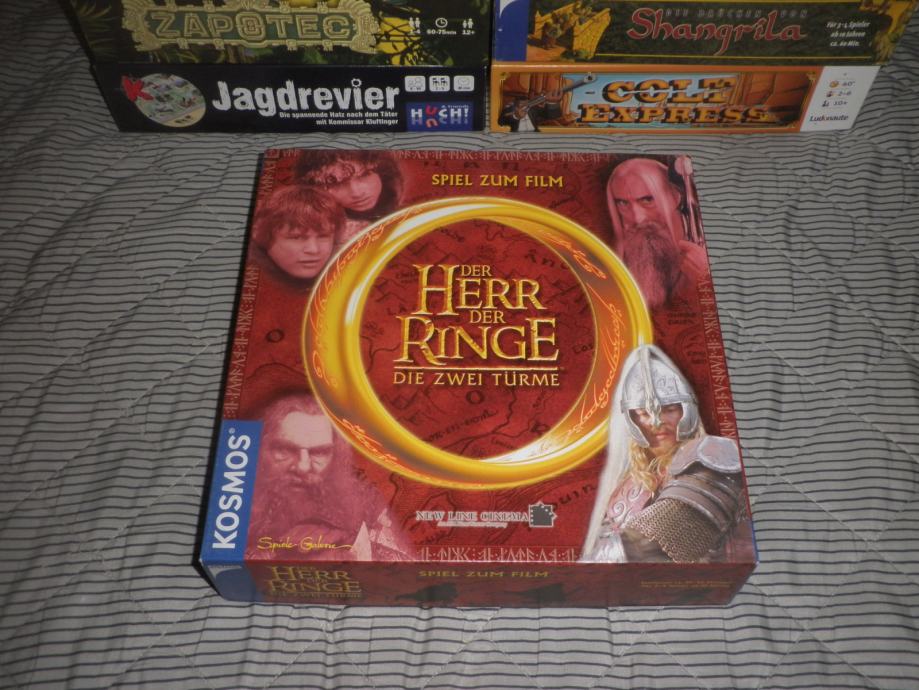
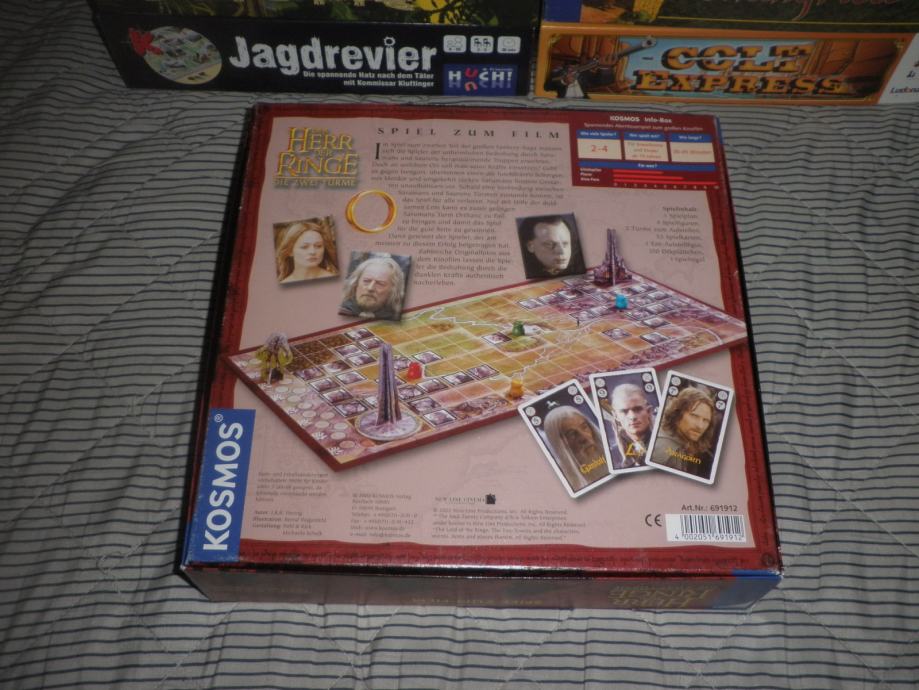
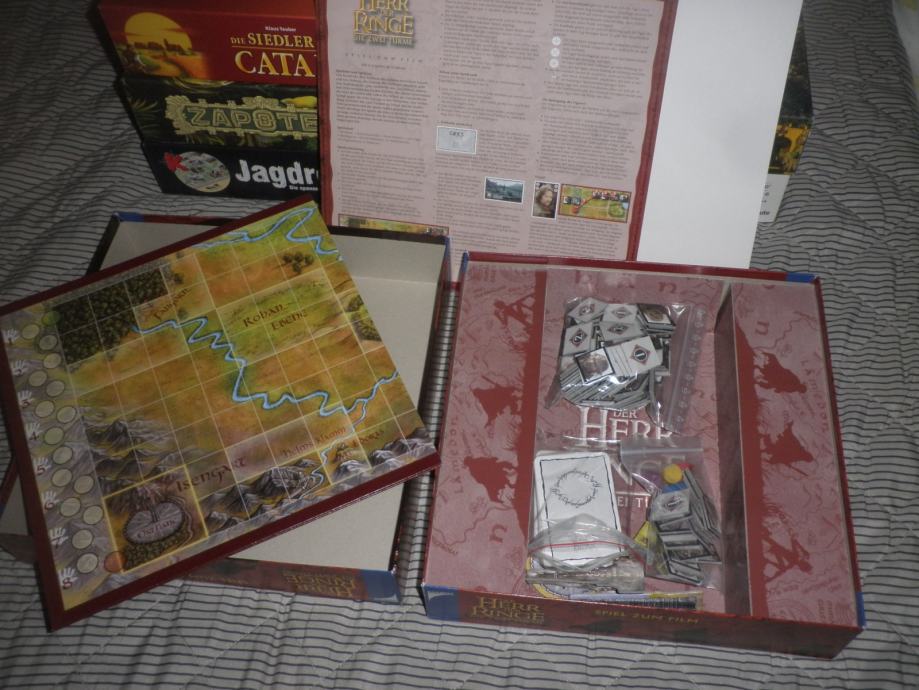
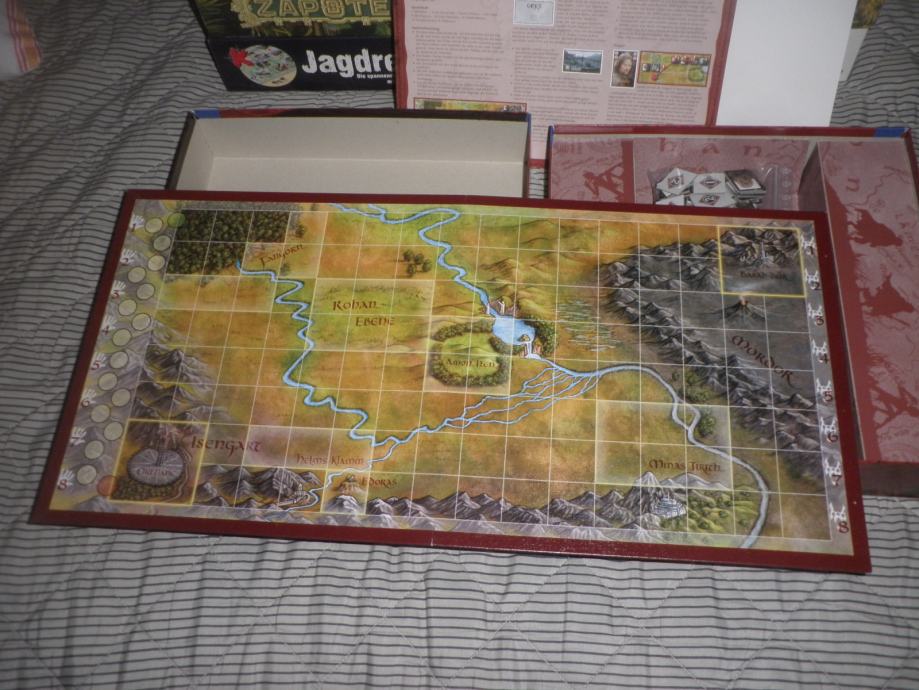
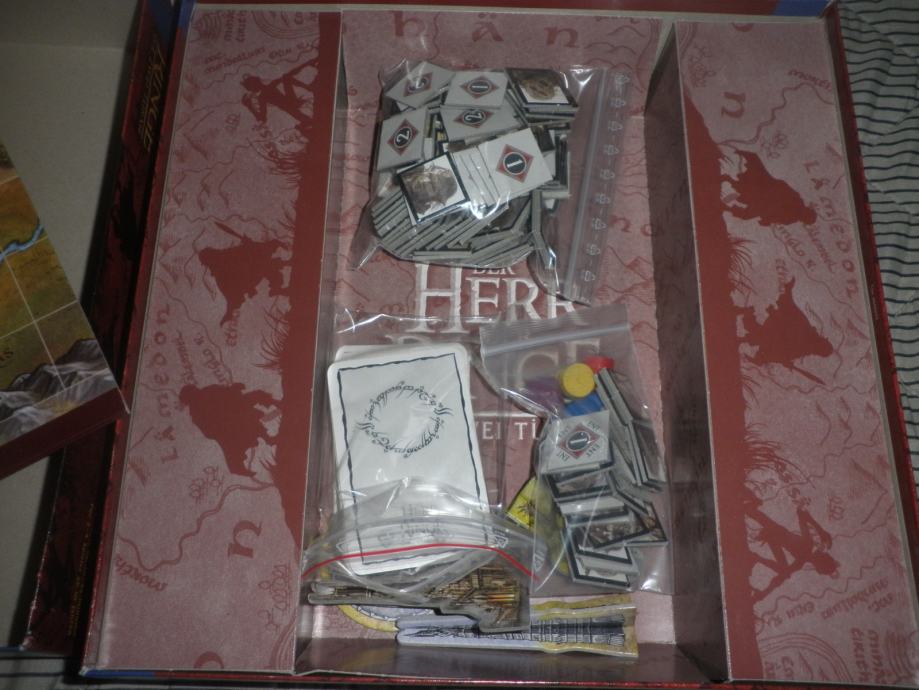
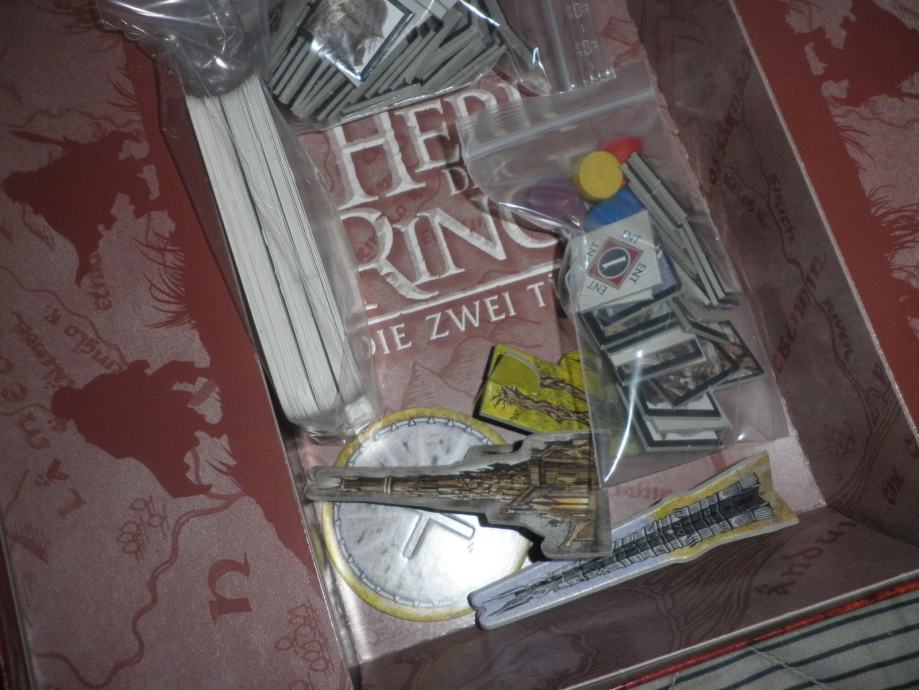
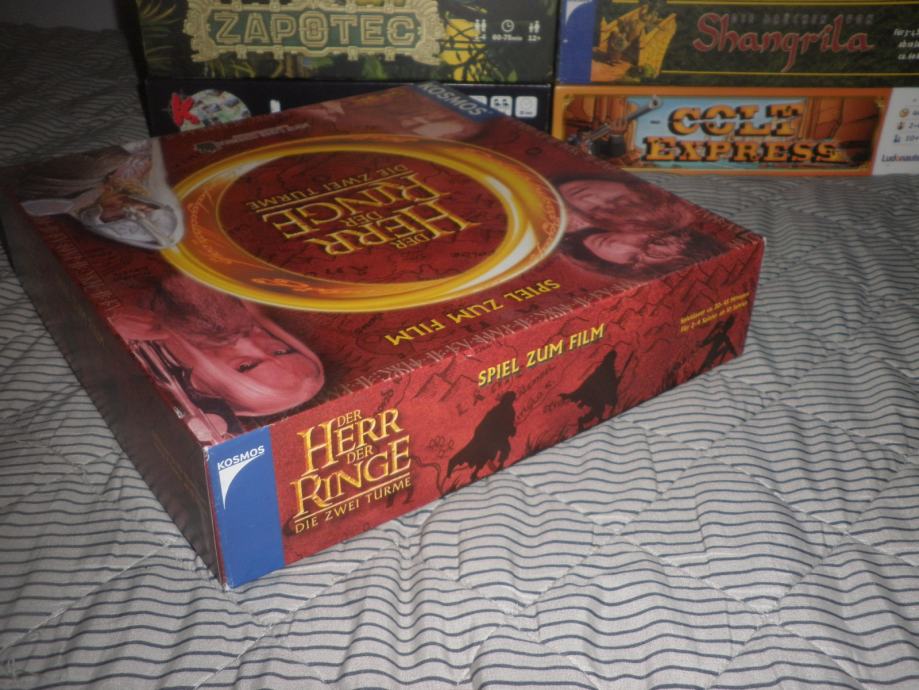
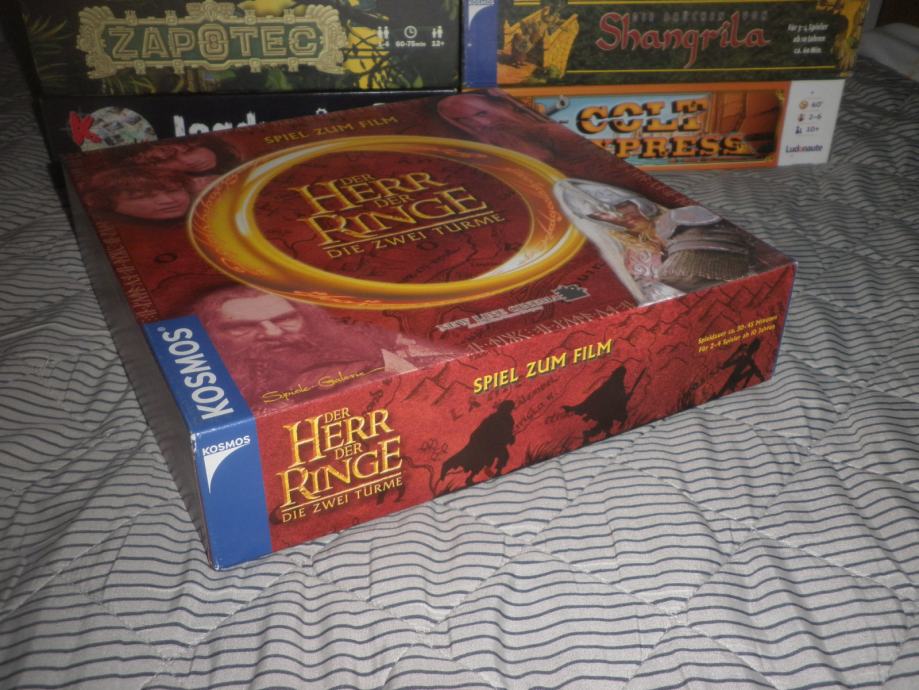
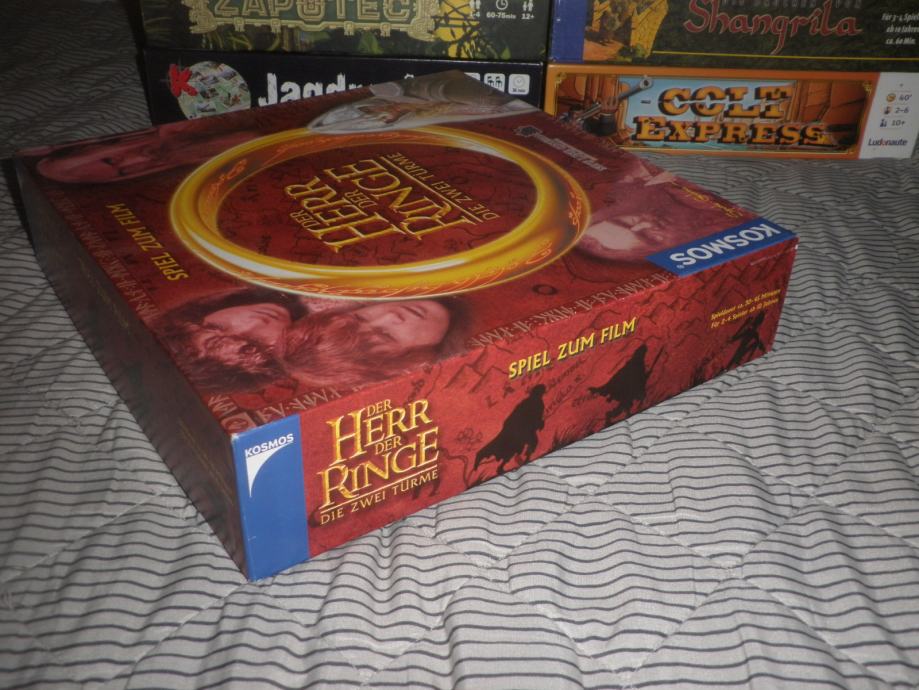
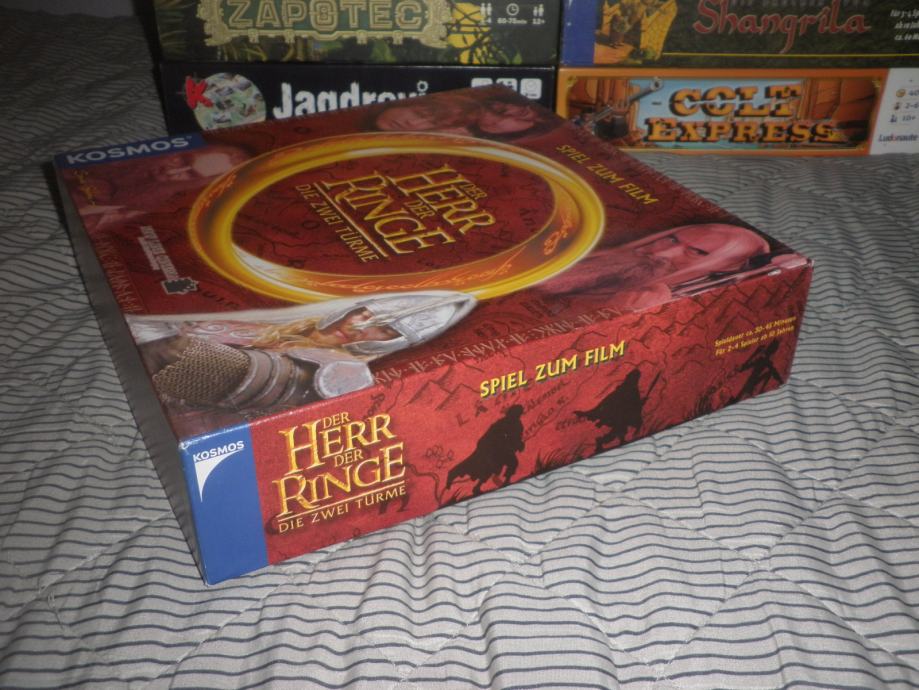


DER HERR DER RINGE : Die Zwei Türme - društvena igra do 4 igrača
- Cijena
- 19,99 €
+ zaštita kupca 1,96 €
+ dostava od 1,90 €
Besplatna BOX NOW dostava u appu
Promocija traje do 9.5.2026.
Skini Njuškalo app i ulovi besplatnu dostavu. Više
Kupuj uz PayProtect od provjerenih prodavača uz garanciju povrata novca i sigurnu dostavu. Saznaj više
Šifra oglasa: 45757384
Osnovne informacije
- Lokacija
- Grad Zagreb, Gornja Dubrava, Granešina
- Stanje
- rabljeno
Opis oglasa
LORD OF THE RINGS : TWO TOWERS board game
Očuvana je i kompletna, u odličnom stanju.
Njemačko izdanje, drugo ne postoji :)
Teksta ima jedino na 14 karata za koje postoji prijevod pri dnu opisa oglasa
https://boardgamegeek.com/boardgame/4983/der-herr-der-ringe-die-zwei-turme
Zagreb može primopredaja
098 927 9595
Pravila
Der Herr der Ringe: Die Zwei Türme, Spiel zum Film
(The Lord of the Ring: The Two Towers, game of the film)
Kosmos, 2002
designed by J. R. R. Herring
translated by Pitt Crandlemire
For 2-4 players from 10 years
Idea and goal of the game
From Barad-dûr, the bulwark of the dark lord Sauron, and from Orthanc, the fortress of the wizard Saruman, a threat goes out to all of Middle Earth. Innumerable, nameless Orcs stream forth from both towers. The players support the side of good and guide the heroes of the story in the fight against the Orcs. If the Orc hordes succeed in forming a connection between the two towers, the dark side will have won and the players will all lose together. If, in their continuing quest, the players can hold back the Orcs for a very long time indeed, until the Ents reach Orthanc, then the player who has contributed the most to this success wins the game.
Contents
1 gameboard, 1 tower of Barad-dûr, 1 tower of Orthanc, 1 Ent figure, 4 player pawns, 150 Orc tiles, 32 hero cards, 14 event cards, 9 Orc cards
Set-up
- Before the first game, carefully punch out the 150 Orc tiles, the parts for the two towers, and the Ent figure. The towers and the Ent need to be assembled. The tower of Orthanc is also then slipped into the round disk from the bottom up. See the illustration on the cardboard frame which contained the pieces and the photo on the back of the box.
- The two towers are placed on the appropriately named spaces on the board.
- The Ent is placed on the dark green circle at the beginning of the Ent movement track.
- The Orc tiles are thoroughly mixed and laid out picture side up next to the two narrow sides of the board.
- Put one Orc from the reserve on each of the five spaces around both of the two towers. Place them picture side up; no one may look at the reverse side.
- The 14 event cards are sorted by the number on the back, shuffled separately, and placed as a face-down stack next to the Ent movement track. The "3" cards should be on the bottom of the stack, covered by the "2" cards, and, finally topped by the "1" cards.
- The 9 Orc cards are shuffled and placed as a face-down stack on the other side of the board.
- The 32 hero cards are shuffled and each player is dealt 3 as his hand. The remaining cards form a face-down draw deck.
- Finally, each player takes a player pawn. Starting with green, the players put their pawn figure on any unoccupied space in the start area in the middle of the board (Amon Hen). With three players, one pawn is put back in the box. With two players, each player gets two pawns.
- The player with the green pawn begins the game and play then continues in clockwise order.
Course of a turn
On his turn, a player executes the following four actions, one after the other:
1. Turn over an Orc card: The Orcs stream out of Mordor and Isengard and threaten Middle Earth.
2. Play a hero card: The heroes intervene in these events and vanquish Orcs.
3. Draw a hero card: New heroes prepare to enter the fray.
4. Evaluate defeated Orcs: Sometimes an event still occurs after the victory over the Orcs
1. Turn over an Orc card
The player turns over the topmost card of the Orc stack. This card indicates how many Orcs come onto the board and from which side of the board and in which row they enter.
Orcs that come from Isengard enter from the left side of the board in rows 4, 5, 6, or 7. Orcs that are sent out from Mordor enter from the right side of the board in rows 2, 3, 4, or 5. Note: one of the nine cards causes Orcs to enter from both sides of the board.
- The player now takes now as many Orc tiles from stock as indicated on the card (3 in the example) and puts them on the first unoccupied spaces in the indicated row (4 in the example).
- The Orc tiles are placed picture side up; no one may look at the reverse side.
- Should any of the spaces of that row closest to that side of the board be occupied either by Orcs or player pawns, the Orc tiles are placed on the first available unoccupied spaces in that row, one tile to a space.
- Should the indicated row have no unoccupied spaces, no more Orcs can be placed in this row.
The Orc card is then placed in a face-up discard pile. As soon as all nine Orc cards have been used, they are reshuffled and placed in a new draw pile.
2. Play a hero card
- A player moves his pawn over the gameboard by means of the hero cards. Each card shows a strength number and a symbol in the corners.
- The strength number indicates how far a player may move his pawn during his turn. However, he must reduce his strength by one point for each Orc that is horizontally or vertically (not diagonally) adjacent to his pawn.
- The symbols indicate the directions in which the player can move his figure during his turn. There are three different symbols:
[N,S,E,W arrow symbol] The pawn may be moved horizontally or vertically and may make one 90 degree change of direction.
[NE, SE, SW, NE arrow symbol] The pawn may be moved diagonally and may make one 90 degree change of direction.
[8 pointed arrow symbol] The pawn may be moved in a straight line in any direction and may make any one change of direction.
- On the Gandalf card is portrayed a horse symbol representing Gandalf's steed, Shadowfax, with which he can jump to any space on the gameboard.
- The player plays one of his hand cards face-up in front of himself, announces the strength number (as reduced by any adjacent Orcs), and moves his pawn.
Movement of pawns
Movement direction is determined by the symbol on the card. Movement distance is based on the strength number.
- It costs 1 strength point to move into an unoccupied space.
- It cost 2 strength points to move into a space occupied by an Orc. The Orc tile is then defeated and is initially placed in front of the player, still face-down. Note: Although there are eight different Orc pictures on the tiles, they all require the same cost to move into their space and defeat them.
- Spaces containing another player pawn may be moved through as normal, at a cost of 1 strength point, but two player pawns may not remain in the same space.
- Players need not use all available strength points for movement. However, a player must always move his pawn at least one space if possible.
- A player may change the direction of his pawn's movement once per turn according to the symbol on the card. A pawn may never reenter the same space in the same turn, however, thus, back and forth movement is not allowed.
Example:
The red player has played the Aragorn 9 card. Since there is one Orc adjacent to his pawn, he loses 1 strength point and thus has 8 points at his disposal. The diagonally adjacent Orc doesn't reduce his strength. Red moves over the empty space diagonally (1 point used) and then onto the Orc (3 points used). There, he changes direction and moves further horizontally to the right and defeats two additional Orcs (5 and 7 points used). He can't move any further this turn since he has only 1 strength point remaining and, thus, doesn't have enough to enter the next Orc occupied space. Also, since he isn't allowed to change direction a second time, he can't enter any of the other adjacent unoccupied spaces and must therefore lose his last strength point.
Shadowfax
If a player plays the "Gandalf" hero card, he may choose, instead of normal movement, to use Gandalf's steed, "Shadowfax". This allows him to jump his pawn to any space on the board. The space may be unoccupied or it may be occupied by a Orc. In the latter case, the Orc is defeated and is initially placed in front of the player, still face-down. He may not jump to spaces that are occupied by other player pawns.
The pincers
- If a player moves his pawn onto a space such that all the spaces between his pawn and that of another player are completely occupied by Orcs, he has formed a pincers. The Orcs between the two pawns are thus caught in the pincers and defeated. The players take all Orcs from the defeated column and initially place them face down in front of themselves. The player who formed the pincers begins this, alternating with the other player whose pawn was part of the pincers.
- Note: pincers can only be formed in the narrow, vertical direction of the gameboard (column), never in the long, horizontal direction (row).
- With a bit of luck, it is possible to form two sets of pincers with the same move (one upward and one downward).
- A set of pincers can be formed either through normal movement or by use of Shadowfax.
- If the player who formed the pincers still has strength points remaining, he may continue to move.
Example of a pincers move:
The blue player has played the Eomer 8 card. Since there are two Orcs adjacent to his pawn, he loses 2 strength points and, thus, has 6 points at his disposal. He moves one space upward (1 point used) and then one space to the right (2 points used). He then defeats first one Orc (4 points used) and then a second Orc (6 points used). The position of his pawn is then forming a pincers with that of the red player. From the 3 Orcs caught in that pincers, the blue player will take 2 and the red player will take 1.
3. Draw a hero card
After the hero card has been used, it is placed on a face-up discard pile and the player draws a new hero card from the draw pile. Players should always have three cards in their hand. If the hero card draw deck is depleted, shuffle the discard pile to form a new draw deck.
4. Evaluate the Orcs
- At the end of his turn, the player turns over the Orcs that he defeated during his turn. (On those rare occasions when a player defeats no Orcs on his turn, this action is skipped.) If a pincers was formed during the turn, two or more players will have defeated Orcs. The players turn over their Orcs one after the other. The player whose turn it was begins.
- On the back side of each Orc is marked 1, 2, or 3 hero points.
- On some of the 1 tiles the word "Ent" is also marked.
- After the defeated Orc tiles are examined to see if any displayed the word "Ent", they are turned over again (picture side up) and stored in front of that player.
The Ents
If the word "Ent" appeared on the back of an Orc tile, the Ent figure is advanced one space on the Ent movement track. Afterwards, the topmost card of the event card stack is turned over, read, and executed.
The event cards
- There are exactly enough event cards that, if the game ends with the defeat of the dark powers, all the event cards will have been used.
- Some of the event cards refer to certain areas of the board (Amon Hen, Fangorn, Edoras, Minas Tirith, Helm's Deep, Plains of Rohan). Before the first game you should review the empty board so that you will know where these areas are. They are outlined with a lighter border.
- If any Orcs are defeated as the result of an event card, they are taken off the board and put back into the stock. The tiles are not turned over nor revealed.
- After being read and executed, an event card is removed from the game and put back in the box.
End of the game
The game can end in two ways:
1. The two towers are connected by a nonstop chain of Orks. The Orcs in the chain must lie side-by-side horizontally or vertically, diagonal connections don't count as part of the chain. As soon as the two towers are connected, the dark powers win and all the players lose the game.
Example of a lost game:
If the circled Orc in row 4 was not in place, the chain would not be closed since the two Orcs adjacent to it are only connected diagonally, which doesn't count for completing an Orc chain. Also, the two Orcs in row 3 are not connected to each other because the red player's pawn interrupts the chain.
or
2. The Ent figure reaches the last (brown) space of the Ent movement strip. In this case, there will also be no more unused event cards left. Now, the dark powers have been defeated. The players add up the hero points on their Orc tiles. The player with the highest hero point total wins. In the event of a tie, the tied player with the most Orc tiles wins.
Special rules for a two player game
In the two player game, each of the two players has two pawns. The player can decide each turn which of his two pawns he wishes to move. He is not required to move his pawns in alternating fashion. If he finds it to be tactically useful, he can move the same pawn several turns in a row, while not moving the other at all. It is also possible for a player to form a pincers using only his own pawns.
Game variant
Players desiring a greater challenge can begin the game with an additional ring of Orcs around Orthanc or Barad-dûr. As a result, there will be an extra seven Orcs already on the board at the beginning of the game. Even more audacious players can lay a second ring of Orcs around both towers. Only time will tell what odds our heroes will have then...
Event Cards
"1" cards
Die Orks bedrohen Minas Tirith. Setze auf jedes freie Feld der sechs Felder vor Minas Tirith einen Ork.
The Orcs threaten Minas Tirith. Place an Orc on each unoccupied space in the six spaces of Minas Tirith.
Die Ostlinge unterstützen Sauron. Aus Mordor werden drei Orks in Reihe 6 gesetzt.
The Easterlings support Sauron. From Mordor, place three Orks in row 6.
Edoras ruft dich. Setze deine Figure sofort auf das Feld Edoras.
Edoras calls to you. Move your pawn immediately to the Edoras space.
Saruman umzingelt den Fangorn-Wald. Setze auf jedes freie Feld der sechs Felder um Fangorn einen Ork.
Saruman surrounds the Fangorn Forest. Place an Orc on each unoccupied space in the six spaces of Fangorn.
"2" cards
Die Elbenkrieger unterstützen dich. Du schlägst in einer geraden Richtung bis zu drei Felder weit, ohne dich zu bewegen.
The Elven warriors support you. You defeat all Orcs in a straight line up to 3 spaces away from your pawn without moving.
Die Wilderländer bringen Unruhe. Jeder Spieler gibt seine drei Karten seinem linken Nachbarn.
The Wild Men stir unrest. Each player passes his three cards to the player on his left.
Du kommst den Eingeschlossenen von Helms Klamm zur Hilfe. Alle Orks auf den drei Feldern vor Helms Klamm werden in den Vorrat zuruückgelegt.
You come to the aid of Helms' Deep. All Orcs on the three spaces in front of Helm's Deep are put back into the stock.
König Theoden wiedersteht Saruman. Lege zwei Orks, die an Orthanc angrenzen, in den Vorrat zurück.
King Theoden resists Saruman. Put two Orcs that are adjacent to Orthanc back into the stock.
Merry und Pippin marschieren mit Baumbart gegen Orthanc. Setze die Ent-Figur ein Feld vor.
Merry and Pippin march on Orthanc with Treebeard. Move the Ent figure one space forward.
Saurons Auge erspäht alles. Setze auf jedes freie Feld der vier Felder von Amon Hen einen Ork.
The Eye of Sauron sees all. Place an Orc on each unoccupied space in the four spaces of Amon Hen.
"3" cards
Die Reiter von Rohan kommen zur Hilfe. Alle Orks auf den sechs Feldern der Rohan-Ebene werden in den Vorrat zurückgelegt.
The Riders of Rohan come to your aid. All Ork on the six spaces of the Plains of Rohan-Ebene are placed back into the stock.
Eowyns Mut bestärkt dich. Lege zwei Orks, die an deine Figur angrenzen (auch diagonal), in den Vorrat zurück.
Eowyn's courage strengthens you. Place two Orks that are adjacent to your pawn (including diagonally) back into the stock.
Frodo und Sam ziehen Saurons Aufmerksamkeit auf sich. Lege zwei Orks, die an Barad-dûr angrenzen, in den Vorrat zurück.
Frodo and Sam attract Saurons attention to themselves. Place two Orc that are adjacent to Barad-dûr back into the stock.
Grima Schlangenzunges Einflüsterungen umnebeln dich. Lege deine beiden höchsten Heldenkarten auf den Ablagestapel und ziehe zwei neue.
Grima Wormtongue's insinuations cloud your mind. Discard your two highest hero cards and draw two new cards.
Očuvana je i kompletna, u odličnom stanju.
Njemačko izdanje, drugo ne postoji :)
Teksta ima jedino na 14 karata za koje postoji prijevod pri dnu opisa oglasa
https://boardgamegeek.com/boardgame/4983/der-herr-der-ringe-die-zwei-turme
Zagreb može primopredaja
098 927 9595
Pravila
Der Herr der Ringe: Die Zwei Türme, Spiel zum Film
(The Lord of the Ring: The Two Towers, game of the film)
Kosmos, 2002
designed by J. R. R. Herring
translated by Pitt Crandlemire
For 2-4 players from 10 years
Idea and goal of the game
From Barad-dûr, the bulwark of the dark lord Sauron, and from Orthanc, the fortress of the wizard Saruman, a threat goes out to all of Middle Earth. Innumerable, nameless Orcs stream forth from both towers. The players support the side of good and guide the heroes of the story in the fight against the Orcs. If the Orc hordes succeed in forming a connection between the two towers, the dark side will have won and the players will all lose together. If, in their continuing quest, the players can hold back the Orcs for a very long time indeed, until the Ents reach Orthanc, then the player who has contributed the most to this success wins the game.
Contents
1 gameboard, 1 tower of Barad-dûr, 1 tower of Orthanc, 1 Ent figure, 4 player pawns, 150 Orc tiles, 32 hero cards, 14 event cards, 9 Orc cards
Set-up
- Before the first game, carefully punch out the 150 Orc tiles, the parts for the two towers, and the Ent figure. The towers and the Ent need to be assembled. The tower of Orthanc is also then slipped into the round disk from the bottom up. See the illustration on the cardboard frame which contained the pieces and the photo on the back of the box.
- The two towers are placed on the appropriately named spaces on the board.
- The Ent is placed on the dark green circle at the beginning of the Ent movement track.
- The Orc tiles are thoroughly mixed and laid out picture side up next to the two narrow sides of the board.
- Put one Orc from the reserve on each of the five spaces around both of the two towers. Place them picture side up; no one may look at the reverse side.
- The 14 event cards are sorted by the number on the back, shuffled separately, and placed as a face-down stack next to the Ent movement track. The "3" cards should be on the bottom of the stack, covered by the "2" cards, and, finally topped by the "1" cards.
- The 9 Orc cards are shuffled and placed as a face-down stack on the other side of the board.
- The 32 hero cards are shuffled and each player is dealt 3 as his hand. The remaining cards form a face-down draw deck.
- Finally, each player takes a player pawn. Starting with green, the players put their pawn figure on any unoccupied space in the start area in the middle of the board (Amon Hen). With three players, one pawn is put back in the box. With two players, each player gets two pawns.
- The player with the green pawn begins the game and play then continues in clockwise order.
Course of a turn
On his turn, a player executes the following four actions, one after the other:
1. Turn over an Orc card: The Orcs stream out of Mordor and Isengard and threaten Middle Earth.
2. Play a hero card: The heroes intervene in these events and vanquish Orcs.
3. Draw a hero card: New heroes prepare to enter the fray.
4. Evaluate defeated Orcs: Sometimes an event still occurs after the victory over the Orcs
1. Turn over an Orc card
The player turns over the topmost card of the Orc stack. This card indicates how many Orcs come onto the board and from which side of the board and in which row they enter.
Orcs that come from Isengard enter from the left side of the board in rows 4, 5, 6, or 7. Orcs that are sent out from Mordor enter from the right side of the board in rows 2, 3, 4, or 5. Note: one of the nine cards causes Orcs to enter from both sides of the board.
- The player now takes now as many Orc tiles from stock as indicated on the card (3 in the example) and puts them on the first unoccupied spaces in the indicated row (4 in the example).
- The Orc tiles are placed picture side up; no one may look at the reverse side.
- Should any of the spaces of that row closest to that side of the board be occupied either by Orcs or player pawns, the Orc tiles are placed on the first available unoccupied spaces in that row, one tile to a space.
- Should the indicated row have no unoccupied spaces, no more Orcs can be placed in this row.
The Orc card is then placed in a face-up discard pile. As soon as all nine Orc cards have been used, they are reshuffled and placed in a new draw pile.
2. Play a hero card
- A player moves his pawn over the gameboard by means of the hero cards. Each card shows a strength number and a symbol in the corners.
- The strength number indicates how far a player may move his pawn during his turn. However, he must reduce his strength by one point for each Orc that is horizontally or vertically (not diagonally) adjacent to his pawn.
- The symbols indicate the directions in which the player can move his figure during his turn. There are three different symbols:
[N,S,E,W arrow symbol] The pawn may be moved horizontally or vertically and may make one 90 degree change of direction.
[NE, SE, SW, NE arrow symbol] The pawn may be moved diagonally and may make one 90 degree change of direction.
[8 pointed arrow symbol] The pawn may be moved in a straight line in any direction and may make any one change of direction.
- On the Gandalf card is portrayed a horse symbol representing Gandalf's steed, Shadowfax, with which he can jump to any space on the gameboard.
- The player plays one of his hand cards face-up in front of himself, announces the strength number (as reduced by any adjacent Orcs), and moves his pawn.
Movement of pawns
Movement direction is determined by the symbol on the card. Movement distance is based on the strength number.
- It costs 1 strength point to move into an unoccupied space.
- It cost 2 strength points to move into a space occupied by an Orc. The Orc tile is then defeated and is initially placed in front of the player, still face-down. Note: Although there are eight different Orc pictures on the tiles, they all require the same cost to move into their space and defeat them.
- Spaces containing another player pawn may be moved through as normal, at a cost of 1 strength point, but two player pawns may not remain in the same space.
- Players need not use all available strength points for movement. However, a player must always move his pawn at least one space if possible.
- A player may change the direction of his pawn's movement once per turn according to the symbol on the card. A pawn may never reenter the same space in the same turn, however, thus, back and forth movement is not allowed.
Example:
The red player has played the Aragorn 9 card. Since there is one Orc adjacent to his pawn, he loses 1 strength point and thus has 8 points at his disposal. The diagonally adjacent Orc doesn't reduce his strength. Red moves over the empty space diagonally (1 point used) and then onto the Orc (3 points used). There, he changes direction and moves further horizontally to the right and defeats two additional Orcs (5 and 7 points used). He can't move any further this turn since he has only 1 strength point remaining and, thus, doesn't have enough to enter the next Orc occupied space. Also, since he isn't allowed to change direction a second time, he can't enter any of the other adjacent unoccupied spaces and must therefore lose his last strength point.
Shadowfax
If a player plays the "Gandalf" hero card, he may choose, instead of normal movement, to use Gandalf's steed, "Shadowfax". This allows him to jump his pawn to any space on the board. The space may be unoccupied or it may be occupied by a Orc. In the latter case, the Orc is defeated and is initially placed in front of the player, still face-down. He may not jump to spaces that are occupied by other player pawns.
The pincers
- If a player moves his pawn onto a space such that all the spaces between his pawn and that of another player are completely occupied by Orcs, he has formed a pincers. The Orcs between the two pawns are thus caught in the pincers and defeated. The players take all Orcs from the defeated column and initially place them face down in front of themselves. The player who formed the pincers begins this, alternating with the other player whose pawn was part of the pincers.
- Note: pincers can only be formed in the narrow, vertical direction of the gameboard (column), never in the long, horizontal direction (row).
- With a bit of luck, it is possible to form two sets of pincers with the same move (one upward and one downward).
- A set of pincers can be formed either through normal movement or by use of Shadowfax.
- If the player who formed the pincers still has strength points remaining, he may continue to move.
Example of a pincers move:
The blue player has played the Eomer 8 card. Since there are two Orcs adjacent to his pawn, he loses 2 strength points and, thus, has 6 points at his disposal. He moves one space upward (1 point used) and then one space to the right (2 points used). He then defeats first one Orc (4 points used) and then a second Orc (6 points used). The position of his pawn is then forming a pincers with that of the red player. From the 3 Orcs caught in that pincers, the blue player will take 2 and the red player will take 1.
3. Draw a hero card
After the hero card has been used, it is placed on a face-up discard pile and the player draws a new hero card from the draw pile. Players should always have three cards in their hand. If the hero card draw deck is depleted, shuffle the discard pile to form a new draw deck.
4. Evaluate the Orcs
- At the end of his turn, the player turns over the Orcs that he defeated during his turn. (On those rare occasions when a player defeats no Orcs on his turn, this action is skipped.) If a pincers was formed during the turn, two or more players will have defeated Orcs. The players turn over their Orcs one after the other. The player whose turn it was begins.
- On the back side of each Orc is marked 1, 2, or 3 hero points.
- On some of the 1 tiles the word "Ent" is also marked.
- After the defeated Orc tiles are examined to see if any displayed the word "Ent", they are turned over again (picture side up) and stored in front of that player.
The Ents
If the word "Ent" appeared on the back of an Orc tile, the Ent figure is advanced one space on the Ent movement track. Afterwards, the topmost card of the event card stack is turned over, read, and executed.
The event cards
- There are exactly enough event cards that, if the game ends with the defeat of the dark powers, all the event cards will have been used.
- Some of the event cards refer to certain areas of the board (Amon Hen, Fangorn, Edoras, Minas Tirith, Helm's Deep, Plains of Rohan). Before the first game you should review the empty board so that you will know where these areas are. They are outlined with a lighter border.
- If any Orcs are defeated as the result of an event card, they are taken off the board and put back into the stock. The tiles are not turned over nor revealed.
- After being read and executed, an event card is removed from the game and put back in the box.
End of the game
The game can end in two ways:
1. The two towers are connected by a nonstop chain of Orks. The Orcs in the chain must lie side-by-side horizontally or vertically, diagonal connections don't count as part of the chain. As soon as the two towers are connected, the dark powers win and all the players lose the game.
Example of a lost game:
If the circled Orc in row 4 was not in place, the chain would not be closed since the two Orcs adjacent to it are only connected diagonally, which doesn't count for completing an Orc chain. Also, the two Orcs in row 3 are not connected to each other because the red player's pawn interrupts the chain.
or
2. The Ent figure reaches the last (brown) space of the Ent movement strip. In this case, there will also be no more unused event cards left. Now, the dark powers have been defeated. The players add up the hero points on their Orc tiles. The player with the highest hero point total wins. In the event of a tie, the tied player with the most Orc tiles wins.
Special rules for a two player game
In the two player game, each of the two players has two pawns. The player can decide each turn which of his two pawns he wishes to move. He is not required to move his pawns in alternating fashion. If he finds it to be tactically useful, he can move the same pawn several turns in a row, while not moving the other at all. It is also possible for a player to form a pincers using only his own pawns.
Game variant
Players desiring a greater challenge can begin the game with an additional ring of Orcs around Orthanc or Barad-dûr. As a result, there will be an extra seven Orcs already on the board at the beginning of the game. Even more audacious players can lay a second ring of Orcs around both towers. Only time will tell what odds our heroes will have then...
Event Cards
"1" cards
Die Orks bedrohen Minas Tirith. Setze auf jedes freie Feld der sechs Felder vor Minas Tirith einen Ork.
The Orcs threaten Minas Tirith. Place an Orc on each unoccupied space in the six spaces of Minas Tirith.
Die Ostlinge unterstützen Sauron. Aus Mordor werden drei Orks in Reihe 6 gesetzt.
The Easterlings support Sauron. From Mordor, place three Orks in row 6.
Edoras ruft dich. Setze deine Figure sofort auf das Feld Edoras.
Edoras calls to you. Move your pawn immediately to the Edoras space.
Saruman umzingelt den Fangorn-Wald. Setze auf jedes freie Feld der sechs Felder um Fangorn einen Ork.
Saruman surrounds the Fangorn Forest. Place an Orc on each unoccupied space in the six spaces of Fangorn.
"2" cards
Die Elbenkrieger unterstützen dich. Du schlägst in einer geraden Richtung bis zu drei Felder weit, ohne dich zu bewegen.
The Elven warriors support you. You defeat all Orcs in a straight line up to 3 spaces away from your pawn without moving.
Die Wilderländer bringen Unruhe. Jeder Spieler gibt seine drei Karten seinem linken Nachbarn.
The Wild Men stir unrest. Each player passes his three cards to the player on his left.
Du kommst den Eingeschlossenen von Helms Klamm zur Hilfe. Alle Orks auf den drei Feldern vor Helms Klamm werden in den Vorrat zuruückgelegt.
You come to the aid of Helms' Deep. All Orcs on the three spaces in front of Helm's Deep are put back into the stock.
König Theoden wiedersteht Saruman. Lege zwei Orks, die an Orthanc angrenzen, in den Vorrat zurück.
King Theoden resists Saruman. Put two Orcs that are adjacent to Orthanc back into the stock.
Merry und Pippin marschieren mit Baumbart gegen Orthanc. Setze die Ent-Figur ein Feld vor.
Merry and Pippin march on Orthanc with Treebeard. Move the Ent figure one space forward.
Saurons Auge erspäht alles. Setze auf jedes freie Feld der vier Felder von Amon Hen einen Ork.
The Eye of Sauron sees all. Place an Orc on each unoccupied space in the four spaces of Amon Hen.
"3" cards
Die Reiter von Rohan kommen zur Hilfe. Alle Orks auf den sechs Feldern der Rohan-Ebene werden in den Vorrat zurückgelegt.
The Riders of Rohan come to your aid. All Ork on the six spaces of the Plains of Rohan-Ebene are placed back into the stock.
Eowyns Mut bestärkt dich. Lege zwei Orks, die an deine Figur angrenzen (auch diagonal), in den Vorrat zurück.
Eowyn's courage strengthens you. Place two Orks that are adjacent to your pawn (including diagonally) back into the stock.
Frodo und Sam ziehen Saurons Aufmerksamkeit auf sich. Lege zwei Orks, die an Barad-dûr angrenzen, in den Vorrat zurück.
Frodo and Sam attract Saurons attention to themselves. Place two Orc that are adjacent to Barad-dûr back into the stock.
Grima Schlangenzunges Einflüsterungen umnebeln dich. Lege deine beiden höchsten Heldenkarten auf den Ablagestapel und ziehe zwei neue.
Grima Wormtongue's insinuations cloud your mind. Discard your two highest hero cards and draw two new cards.
Karta
Napomena: Prikazana je približna lokacija
VedranovOrmar
Korisnik je verificirao broj telefona u državi: Hrvatska
Korisnik nije trgovac te na njega nisu primjenjive EU odredbe o zaštiti potrošača
- Adresa: 10040 Zagreb, Grad Zagreb, Hrvatska
-
- Oglas objavljen
- 09.04.2026. u 08:13
- Do isteka još
- Oglas prikazan
- 2578 puta
VedranovOrmar
Korisnik je verificirao broj telefona u državi: Hrvatska
Korisnik nije trgovac te na njega nisu primjenjive EU odredbe o zaštiti potrošača
- Adresa: 10040 Zagreb, Grad Zagreb, Hrvatska
-