

Maurois, PROUST: PORTRAIT OF A GENIUS
- Cijena
- 12 €
+ zaštita kupca 1,96 €
+ dostava od 1,90 €
Sigurna kupovina uz PayProtect
Dostava diljem Hrvatske

Kupuj uz PayProtect od provjerenih prodavača uz garanciju povrata novca i sigurnu dostavu. Saznaj više
Šifra oglasa: 43897960
Osnovne informacije
- Lokacija
- Grad Zagreb, Donji Grad, Donji grad
- Stanje
- rabljeno
Opis oglasa
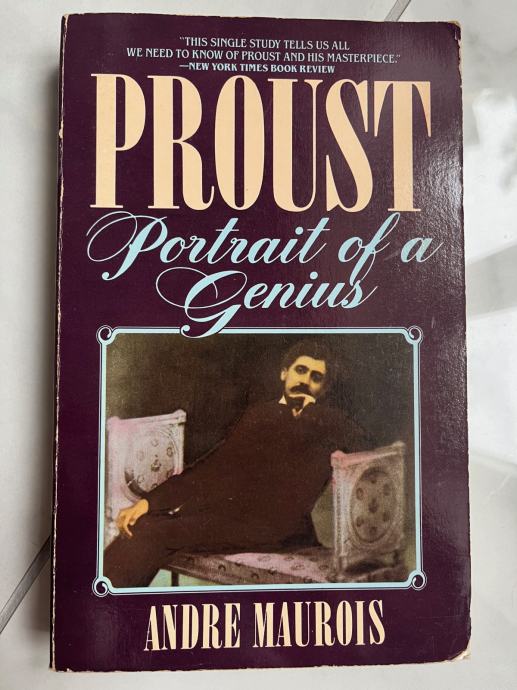
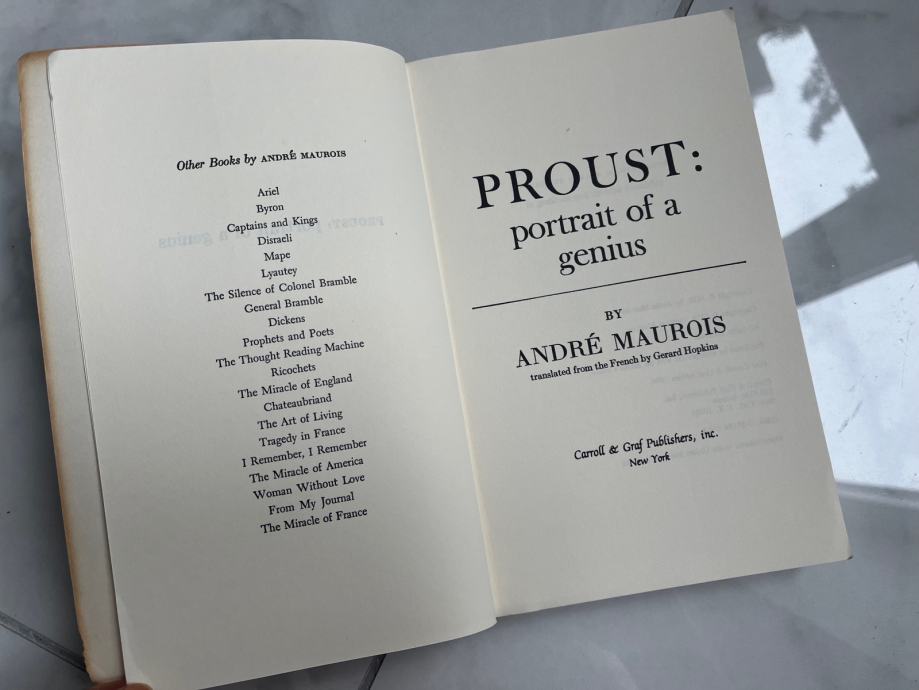
Andre Maurois, PROUST: PORTRAIT OF A GENIUS
Nakladnik CARROLL & GRAF PUBLISHERS INC. New York 1984
Meki uvez. 330 stranica s nekoliko fotografija.
Knjiga je na engleskom jeziku.
French biographer, novelist, essayist , best known for his vivid, romantic style lives of Shelley, Disraëli, Byron, Proust, Balzac, and others. André Maurois's The Quest for Proust is considered by many his finest achievement. Through his wife Simone de Caillavet, who had been a member of the refined circles in which Marcel Proust moved, Maurois had a contact with the world of the reclusive author.
"The minds of different generations are as impenetrable one by the other as are the monads of Leibniz." (from Ariel, 1923)
André Maurois was born Émile Salomon Wilhelm Herzog at Elbeuf, the oldest of three childred of Ernest Herzog (1865-1925), a textile manufacturer, and Alice (Lévy-Rueff) Herzog. The Herzogs had fled Alsace after the Franco-Prussian War (1870) and the refuge was found in Normandy, where they established a woolen mill at Elbeuf. At the time of their sons birth, Ernest and Alice lived at the corner of the rue Henry and the Place du Champ de Foire, near Elbeuf's center.
Maurois had a happy childhood. At school he was a hardworking, brilliant student. He was educated at the lycée of Elbeuf and Rouen, received barchelor's degree in letters and science and continued for a degree in philosophy at the University of Caen. From the age of eighteen to twenty-six he worked at his father's factory. He was a vey successsful businessman.
When the World War I broke out, Maurois was first attached as an interpreter. Overestimating his knowledge of English, Maurois was then made a liaison officer to the British Army. Jeanne-Marie (Janine) Wanda de Szymkiewicz (1892-1924), his first wife, was a Russian girl of Polish descendt, who grew up in Switzerland and had studied at Oxford. They married in 1912. During the war she entered into affairs, and had a nervous breakdown in 1918. Later Maurois portrayed a similar character in Le cercle de famille (1932). She died of septicemia in 1924, at the age of thirty-two, leaving behind three young children.
As a novelist Maurois made his debut with The Silence of Colonel Bramble (1918), which was based on his experiences in the war. Anticipating that the caricatures of British soldiers might embrass his friends, he adopted a pseudonym: "Maurois" was the name of a village near Cambrai where he had been engaged in combat, "André" came from a cousin who was killed in the war. In 1947 André Maurois became his legal name. The novel was a bestseller on both sides of the Channel. Bernard Grasset, his publisher, commissioned him to write a sequel, Les Discours du Docteur O'Grady (1922, The Discourses of Doctor O'Grady).
Maurois returned from the front with hair turned completely white. After the death his father in 1925, Maurois gave up the family business. He had moved in 1919 from Elbeuf to Paris, where he was welcomed by the literary circles. Part of the year he had spent at La Sayasse, within easy access to the factory.
During the 1920s Maurois traveled in England where he researched for his biography of the poet Shelley and met Harold Nicholson, Maurice Baring, Bloomsbury circle of writers, and notables of high British society. In 1926 he married Simone de Caillavet, the daughter of the playwright Gaston de Caillavet and the granddaughter of Anatole France's mistress Léontine Arman de Caillavet. Into her marriage she brought her little daughter from her former annulled marriage to a nonliterary Rumanian diplomat, and estate and chateau, Essendiéras, situated near the village of St. Médard d'Excideuil. Maurois's stepdaughter, Françoise-Georgina, died of cirrhosis of the liver during a vacation in the Alps.
Ni ange, ni bête (1919) was inspired by the story of Percy Shelley and his first wife Harriet Westbrook. The book was set in Abbeville, a town where Maurois had been stationed with the British Army. Maurois's light-hearted biography of Shelley, Ariel, established his fame as an interpreter of the Anglo-Saxon mind to the French public, and encouraged him to publish novelistic biographies. Although readers were delighted, Maurois's accurcy was attacked by reviewers, and moreover, he was accused of plagiarism by a young critic in 'Un Ecrivain Original. M. André Mauriois (suite)', an article published in 1928 in the Mercure de France. The English journalist and literary editor Frank Harris stated that sections of Maurois's essay on Oscar Wilde in Études Anglaises (1927) had been lifted from his own book, Oscar Wilde, His Life and Confessions (1916). Noteworthy, Harris himself was known for taking liberties with facts.
It was a lesson learned for Maurois and after this public controversy his historical works followed academic standards and were meticulously researched. He once stated: "I am never satisfied to do a hasty or improvised job when asked to write or speak." When writing fiction, Maurois moved from facts to imagination. Le pays des trente-six mille volontés (1928, The Country of Thirty-six Thousand Wishes), a fantasy tale, featured a country where eight times six equals anything one want. It is a place where one will end up after trying unsuccessfully to learn La Fontaine's poem 'The Fox and the Crow' by heart.
The sales of his books made Maurois financially independent and offered him an escape from being just another biographer. His idealism and romantic conception of life he channeled into his literary work. One of his characters, Philippe Marcenats, says in Climats (1928): "I used to compare my life to a symphony wherein mingled several themes: the theme of the Knight, the theme of the cynic, the theme of the rival." While traveling in Italy in search of records of the lives of Lord Byron and Chateaubriand, Maurois met Benito Mussolini. In Marocco he met Marshal Lyautey, whose biography he would later write.
At Trinity College, Cambridge, Maurois gave in May 1928 a series of lectures in which he devoleped further his ideas about the writing of lives. The preceding year lectures had been given by E.M. Forster. The notes he had used Maurois re-cast in book form, entitled Aspects de la biographie (1928, Aspects of Biography). "It is quite possible to discover and to record defamatory anecdotes abour a writer of genius or a statesman, but is he, when thus revealed, more truly an ordinary man than the jero whom a whole people hs seen in him?" 'Maurois asked in the first lecture. "Perhaps the hero was nothing but a mask, but cannot the mask become the real personality?" Questioning the juxtaposition of the exact and historical sciences, Maurois argued that art and science can be reconciled and that poetry and rhythm are as essential to biography as to other forms of art.
In the following decades, Simone Maurois, gifted with a "merciless memory" became his material and spiritual collaborator, and saved him a lot of work in tracking down historical and biographical information. As a hobby, she collected autographed letters of famous people. "Why do I love my wife?" wrote Maurois in The Art of Being Happily Married (1951). "Well she has the same tastes as I. . . . My wife gives her life to my work, she is my social secretary; she works ten hours per day – and sometimes into the night – and always works well. . . ."
Maurois's union with Simone was productive. During the 1920s and 1930s he published biographies of Shelley (1923), Disraeli (1927), Byron (1930), Voltaire (1932), King Edward (1933) and Chateaubriand (1938). Maurois's visit of 1927 in America, where he became a well-known figure, led to a life-long interest in the culture and history of the country. In 1929 Maurois received an invitation from Princeton. Besides giving a formal course on the French novel, he delivered a series of public lectures. For his surprise, he learned that Woodrow Wilson, whom he greatly admired, was a controversial figure in his own college town. As a result, he eventually abandoned plans to write a biography on the president-statesman. Maurois's opinions ranging from Huey Long to the New Deal were widely quoted. "One cannot help calling to mind," Maurois said of Roosevelt's banking reform bill, "as one writers the history of these three crowded months, the Biblical account of the creation."
As a recognition of his work, Maurois was appointed a member of the French Academy in 1938. During World War II Maurois served as a captain of the French army and was first attached as a liaison officer to British General Headquarters. After Germany occupied France, Maurois moved with his wife to the Unites States to help with propaganda work.
However, Maurois was not a Gaullist but one of the few French writers, who supported the Vichy regime – France "will have, perhaps for a long time, to follow a middle course between what she would like to do and what she feels compelled to do," Maurois wrote in an article, in which he expressed his respect to Marshal Pétain (Life, January 6, 1941). Britain's Consul General reported that Mme Simone Maurois was very anxious to get back to France. In the eyes of the Nazis, he was a Jew, and he would have been transported to death camp. His large collection of book had been seized by Heinrich Himmler's RSHA (SS-Reichssicherheitshauptamt) and taken to Berlin. In addition to helping in the war effort, Maurois lectured at University of Kansas City and Mills Colege and wrote several biographies for young readers, among them lives of Frédéric Chopin (1942), General Eisenhower (1945), Franklin (1945), and Washington (1946).
In 1943 Maurois joined his writer-associate Antoine de Saint-Exupéry to serve with the Allied Forces in North Africa. They had known each other a long period and had became friends in America. "Either he dominated the conversation or he dreamed of another planet," Maurois said of his friend, who disappeared during flight in 1944.
Maurois returned to France in 1946 and entered a new phase in his life. He published several works on French authors; Marcel Proust (1949), George Sand (1953), Victor Hugo (1954) and Balzac (1965). The Life of Sir Alexander Fleming (1959) was written on the request of Lady Amalia Fleming. His histories include The Miracle of England (1937), The Miracle of America (1944), and The Miracle of France (1948). In addition, Maurois contributed articles to Opéra, Elle and other magazines. In 1951, when Joseph L. Mankiewicz's All About Eve was awarded the Special Jury Prize at the Cannes Cannes Film Festival, he served for the first time as President of the jury. On a lecture tour in Italy he met Pope Pius XII in the Vatican, and discussed with him the literary style of Bossuet's Oraison funèbres.
Besides non-fiction, Maurois wrote a juvenile book, drama, short stories, essays, and science fiction, which drew more from the satire Cyrano de Bererac and Voltaire than from Jules Verne's popular adventure stories. Maurois lured his readers by convincing settings and approved facts, but step by step they enter into the realm of fantasy. "The best method is to begin by a simple tales," Maurois once explainend his technique, "in which no unreal element is present and then to introduce the extraordinary elements only in growing doses which are gradually incorporated into the paste." (The Worlds of André Maurois by Jack Kolbert, 1985) In The Weigher of Souls (1931) a doctor experiments with élan vital and in La machine à lire les pensées (1937) a university professor is initiated into mysteries of a photographic film that records secret thoughts. Maurois's first story was 'La dernière histoire du monde' (1903), a future history, which was included in Premiers contes (1935).
During his final years Maurois continued to work tirelessly. He sat at his table either in the study of his Neuilly apartment, where he had a library of more than 10,000 volumes, or he wrote on the second floor of his Chateau d'Essendiéras. Maurois died of a pulmonary congestion on October 9, 1967. He was buried in the old cemetary of Neuilly. His death was given worldwide attention.
As a biographer Maurois is considered unsurpassed. From the beginning of his career, he defined biography as literary art and craft, but at the same time, he demonstrated a recognition of the necessity of research and documentation. His methods, empathetic identification with his subject, dialogue, and representations of inner thoughts and feelings, made his biographies easy to read as novels.
Selected works and translations:
Les Silences du colonel Bramble, 1918
- The Silence of Colonel Bramble (tr. Thurfrida Wake, 1920) / General Bramble (tr. Jules Castier and Ronald Boswell, 1921)
Ni ange, ni bête, 1919
- Neither Angel, Nor Beast (translated by Preston & Sylvie Shires, 2015)
Les bourgeois de Witzheim, 1920
Les Discours du docteur O'Grady, 1922
- The Discourses of Doctor O'Grady (tr. Jules Castier and Ronald Boswell, 1965)
Ariel, ou la Vie de Shelley, 1923
- Ariel: A Shelley Romance (tr. Ella D’Arcy, 1924) / Ariel: The Life of Shelley (tr. Ella D'Arcy, 1924)
- Ariel eli Shelleyn elämä (suom. E. Hagfors, 1925)
Dialogue sur le commandement, 1924
- Captains and Kings: Three Dialogues on Leadership (tr. 1925)
Arabesques, 1925
Les Anglais, 1926
La hausse et la baisse, 1926
Bernard Quesnay, 1926
- Bernard Quesnay (translated by Brian W. Downs, 1927)
Meïpe, ou la Délivrance, 1926
- Mape: The World of Illusion (tr. Eric Sutton, 1926)
Conseils à un jeune français partant pour l'Angleterre, 1927
La conversation, 1927
- Conversation (tr. Yvonne Dufour, 1930)
Petite histoire de l'espèce humaine, 1927
Un essai sur Dickens, 1927
- Dickens (tr. Hamish Miles, 1935)
Études Anglaises, 1927
Le Chapitre suivant, 1927
- The Next Chapter: The War Against the Moon (trans. anon., 1927)
Rouen, 1927
La vie de Disraëli, 1927
- Disraeli: A Picture of the Victorian Age (tr. Hamish Miles, 1927)
Deux fragments d'une histoire universelle, 1928
Aspects de la biographie, 1928
- Aspects of Biography (translated by Sydney Castle Roberts, 1929)
Voyage au pays des Articoles, 1928
- A Voyage to the Island of the Articoles (tr. David Garnett, 1928)
Contact, 1928
Climats, 1928
- Atmosphere of Love (US title; tr. Joseph Collins, 1929) / Whatever Gods May Be (UK title; tr. Joseph Collins, 1929) / The Climates of Love (tr. Violet Schiff and Esmé Cook, 1986); Climates (translated by Adriana Hunter; with an introduction by Sarah Bakewell, 2012)
- Rakkauden murroskaudet (suom. Anna Silfverblad, 1929)
Le pays des trente-six mille volontés, 1928
- The Country of Thirty-six Thousand Wishes (tr. Pauline Fairbanks, 1930)
Fragments d'un journal de vacances, 1928
Selections from André Maurois, 1928
Le côté de Chelsea, 1929
- Chelsea Way (tr. George D. Painter, 1930)
Don Juan; ou, la vie de Byron, 1930 (2 vols.)
- Byron (tr. Hamish Miles, 1930)
Relativisme, 1930
- A Private Universe (tr. Hamish Hiles, 1932)
Patapoufs et Filifers, 1930
- Fatapoufs & Thinifers (UK title; tr. Norman Denny, 1940) / Patapoufs & Filifers (with introd., notes, exercises and vocabulary by Mary Elizabeth Storer, 1948)
Sur le vif : L'Exposition coloniale. Paris, 1931
Lyautey, 1931
- Marshall Lyautey (tr. Hamish Miles, 1931)
Tourguéniev, 1931
Le Peseur d'âmes, 1931
- The Weigher of Souls (tr. Hamish Miles, 1931)
L'Amérique inattendue, 1931
Proust et Ruskin, 1932
Le cercle de famille, 1932
- The Family Circle (tr. Hamish Miles, 1932)
- Perhepiiri (suom. Walter Streng-Renkonen, 1934)
L'anglaise et d'autres femmes, 1932
- Ricochets: Miniature Tales of Human Life (tr. Hamish Miles, 1935)
Mes songes que voici , 1933
Introduction à la Méthode de Paul Valéry, 1933
Chantiers américains, 1933
En Amérique, 1933 (ed. Robert M. Waugh)
Édouard VII et son temps, 1933
- The Edwardian Era (US title; tr. Hamish Miles, 1933) / King Edward and His Times (UK title; tr. Hamish Miles, 1933)
Sentiments et coutumes, 1934
Byron et les femmes, 1934
L'instinct du bonheur, 1934
- A Time for Silence (tr. 1942)
Voltaire, 1935
- Voltaire (tr. Hamish Miles, 1932)
Les Anglais, 1935
Malte, 1935 (illustrated by Philippe Tassier)
Magiciens et logiciens, 1935
- Prophets and Poets (US title; tr. Hamish Miles, 1935) / Poets and Prophets (UK title; tr. Hamish Miles, 1936) / Points of View: From Kipling to Graham Greene (foreword by Georges Lemaitre, 1968)
Premiers contes, 1935
Textes choisis de André Maurois, 1936 (ed. Édouard Maynial)
La Monarchie anglaise: de Victoria à George VI, 1937
La machine à lire les pensées, 1937
- The Thought-Reading Machine (tr. James Whitehall, 1938)
Histoire de l'Angleterre, 1937
- A History of England (UK title; tr. Hamish Miles, 1937) / The Miracle of England (US title; tr. Hamish Miles, 1937)
René ou la Vie de Châteaubriand, 1938
- Chateaubriand: Poet, Statesman, Lover (tr. Vera Fraser, 1938)
Les pages immortelles de Voltaire, 1938 (ed.)
- The Living Thoughts of Voltaire (tr. 1939)
États-Unis 1939, 1939
Discours prononcé dans la séance publique de sa réception à l'Académie Française le jeudi 22 juin 1939, 1939
Un art de vivre, 1939
- The Art of Living (tr. James Whitall, 1940) / An Art of Living (tr. Sergio E. Serrano, 2007)
États-Unis 39: Journal d'un Voyage en Amerique, 1939
Les origines de la Guerre de 1939, 1939
Tragédie en France, 1940
- Tragedy in France (US title; tr. Denver Lindley, 1940) / Why France Fell (UK title; tr. Denver Lindley, 1941)
Études Littéraires, 1941-44 (2 vols.)
Memoires, 1942
- I Remember, I Remember (tr. Denver and Jane Lindley, 1942)
Frédéric Chopin, 1942
- Frédéric Chopin (illustrated by Everett Shinn, tr. Ruth Green Harris, 1942)
Cinq visages de l'amour, 1942
- Seven Faces of Love (tr. Haakon M. Chevalier, 1944)
Histoire des États-Unis, 1943
- The Miracle of America (US title; tr. 1944) / History of the United States: From Wilson to Kennedy (tr. Patrick O’Brian) / A New History of the United States (translated from the French by Denver and Jane Lindley, 1948) / An Illustrated History of the United States (abridged ed.; translation by Denver & Jane Lindley, adapted and revised for this edition by Helen Katel, 1969)
Call No Man Happy, 1943 (tr. Denver and Jane Lindley)
Toujours l'inattendu arrive, 1943
Espoirs et souvenirs, 1943
Eisenhower, 1945
- Eisenhower, the Liberator (tr. 1945)
Franklin, la vie d'un optimiste, 1945
- Franklin: The Life of an Optimist (drawings by Howard Simon, tr. 1945)
Terre Promise, 1945
- Women without Love (tr. Joan Charles, 1945)
The Rôle of Art in Life and Law, 1945 (translated from the French by Arthur W.A. Cowan)
Études américaines, 1945
Washington, the Life of a Patriot, 1946
- Washington: The Life of an Patriot ( illustrated by Henry C. Pitz, tr. 1946)
Journal/ Etat Unis 1946, 1946
- From My Journal (tr. Joan Charles [pseud.], 1948)
Journal d'un Tour en Suisse, 1946
Premiers contes, 1947 (illustrated by R.A. Denville)
Retour en France: Journal, 20 juillet 1946 - 1er janvier 1947, 1947
Des mondes impossibles, 1947
Quand la France s'enrichissait, 1947
Rouen dévasté, 1947
Histoire de France, 1947 (2 vols.)
- The Miracle of France (tr. Henry L. Binsse, 1948) / A History of France (translated from the French by Henry L. Binsse, 1950)
Journal d'un tour en Amérique latine, 1948
- My Latin-American Diary (tr. Frank Jackson, 1953)
J.-L. David, 1948
Poésie et action, 1949 (ed. Louis Chaigne)
Maurois Reader: Novels, Novelettes and Short Stories, 1949 (introd. Anne Fremantle)
Can Our Civilization Be Saved?, 1949
À la recherche de Marcel Proust, 1949
- Proust: Portrait of a Genius (tr. Gerard Hopkins, 1950) / Proust: a Biography (tr. Gerard Hopkins, 1950)
- Marcel Proust (suom. Inkeri Tuomikoski, 1984)
Alain, 1950
Oeuvres complétes, 1950-56 (16 vols.)
Les Nouveaux discours du docteur O'Grady, 1950
- The Return of Doctor O'Grady (tr. Gerard Hopkins, 1951)
Le diner sous les Marronniers, 1951
Rio de Janeiro, 1951 (photographs by Jean Manzon)
Cours de bonheur conjugal, 1951 (play)
- The Art of Being Happily Married (tr. Crystal Herbert, 1953)
Ce que je crois, 1951
Mon ami Léger, 1952
Destins exemplaires, 1952
Lélia ou la Vie de George Sand, 1952
- Lélia, the Life of George Sand (tr. Gerard Hopkins, 1953)
- Sydän ei erehdy (suom. Reijo Wilenius, 1954)
La vie de Cecil Rhodes, 1953
- Cecil Rhodes (tr. Rohan Wadham, 1953)
Lettres à l'inconnue, 1953
- To an Unknown Lady (tr. John Buchanan-Brown, 1957)
Alexandre Dumas: A Great Life in Brief, 1954
Olympio ou la Vie de Victor Hugo, 1954
- Olympio: The Life of Victor Hugo (tr. Gerard Hopkins, 1956)
Centenaire de la mort de Lamennais, 1954
Versailles aux lumières, 1954 (photograps by Hélène Jeanbrau)
Le Poème de Versailles, 1954
- A Vision of Versailles (translated by A.S. Alexander, 1955)
Périgord, 1955 (with Hugues O’Heguerty and Jean Secret)
Portrait de la France et des Français, 1955
Nico: Le petit garçon changé en chien, 1955
Aux Innocents les mains pleines. Proverbe en un acte, 1955
Hollande, 1955 (photographs by Gérald Maurois)
The Women of Paris, 1955 (tr. Norman Denny, photos. by Nico Jesse)
Discours prononcé à l'Académie française pour la réception de Jean Cocteau, 1955
Robert et Elizabeth Browning, 1955
Louis XIV à Versailles, 1955
La France change de visage, 1956 (foreword by Pierre Lazareff)
Les roses de septembre, 1956
- September Roses (tr. Gerard Hopkins, 1958)
'Lecture mon doux plaisir, 1957
- The Art of Writing (tr. Gerard Hopkins, 1960)
Les Trois Dumas, 1957
- The Titans: A Three-generation Biography of the Dumas (US title; tr. Gerard Hopkins, 1957) / Three Musketeers: A Study of the Dumas family (UK title; translated from the French by Gerard Hopkins, 1957)
La Vie de sir Alexander Fleming, 1959
- The Life of Sir Alexander Fleming (tr. Gerard Hopkins, 1959)
- Sir Alexander Fleming (suom. J.A. Hollo, 1961)
Portrait d'un ami qui s'appelait moi, 1959
Dialogues des vivants, 1959
Pour piano seul, 1960
Lafayette in America, 1960 (illustrated by Frank Nicholas)
Paris, 1960
Le monde de Marcel Proust, 1960
- The World of Marcel Proust (translated by Moura Budberg with the assistance of Barbara Creed; special photographs and research by André Ostier, 1974)
Adrienne; ou, la Vie de Mme de La Fayette, 1961
- Adrienne: The Life of the Marquise de La Fayette (tr. Gerard Hopkins, 1961)
Histoire parallèle, 1962 (4 vols., with Luis Aragon)
- From the New Freedom to the New Frontier (tr. Patrick O’Brien, 1963)
De Proust à Camus, 1963
- From Proust to Camus: Profiles of Modern French Writers (tr. Carl Morse and Renaud Bruce, 1966)
Choses Nues, 1963
Napoléon, 1964
- Napoleon: A Pictorial Biography, 1964
- Napoleon (suom. Osmo Mäkeläinen, 1964)
Histoire de l'Allemagne, 1965
- An Illustrated History of Germany (tr. Stephen Hardman, 1966)
De Gide à Sartre, 1965
Une carrière: et autres nouvelles, 1965
Lettre ouverte à un jeune homme sur la conduite de la vie, 1965
- Open Letter to a Young Man (tr. Frances Frenaye, 1968)
Victor Hugo, 1965
- Victor Hugo and His World (tr. Oliver Bernard, 1966)
Prométhée ou la Vie de Balzac, 1965
- Prometheus: The Life of Balzac (tr. Norman Denny, 1966)
Au commencement était l'action, 1966
Soixante ans de ma vie littéraire, 1966
La Vie de Jean-Baptiste Bernadotte, 1966 (foreword, illustrated by Françoise Debaisieux and Gunnar W. Lundberg)
Trois portraits de femmes, 1967
D'Aragon à Montherlant, 1967
The Collected Stories of André Maurois, 1967 (tr. Adrienne Foulke)
La Conquête de l'Angleterre par les Normands, 1967
De la morale médicale: discours aux médecins, 1967
Les Illusions, 1968
- Illusions (tr. 1968)
Mémoires 1885-1967, 1970
- Memoirs: 1885-1967 (tr. Denver Lindley, 1970)
The Art of Happiness: Selected Writings of André Maurois, 1971 (edited by Karen Middaugh)
Le Chapitre suivant: 1927, 1967, 2007, 1979 (preface by Robert Kanters)
Nouvelles extra-terrestres et imaginaires, 1996
Climates, 2012 (Climats; translated from the french by Adriana Hunter; with an introduction by Sarah Bakewell)
Neither Angel, Nor Beast, 2015 (Ni ange, ni bête; translated by Preston & Sylvie Shires)
Postoji mogućnost preuzimanja knjige u širem centru Zagreba.
Poruka na 098 9174 300. Slanje BOX NOW (1 euro), ili TISAK.
Pogledajte i ostale moje oglase, i iskombinirajte narudžbu o jednom putnom trošku.
(128)
Nakladnik CARROLL & GRAF PUBLISHERS INC. New York 1984
Meki uvez. 330 stranica s nekoliko fotografija.
Knjiga je na engleskom jeziku.
French biographer, novelist, essayist , best known for his vivid, romantic style lives of Shelley, Disraëli, Byron, Proust, Balzac, and others. André Maurois's The Quest for Proust is considered by many his finest achievement. Through his wife Simone de Caillavet, who had been a member of the refined circles in which Marcel Proust moved, Maurois had a contact with the world of the reclusive author.
"The minds of different generations are as impenetrable one by the other as are the monads of Leibniz." (from Ariel, 1923)
André Maurois was born Émile Salomon Wilhelm Herzog at Elbeuf, the oldest of three childred of Ernest Herzog (1865-1925), a textile manufacturer, and Alice (Lévy-Rueff) Herzog. The Herzogs had fled Alsace after the Franco-Prussian War (1870) and the refuge was found in Normandy, where they established a woolen mill at Elbeuf. At the time of their sons birth, Ernest and Alice lived at the corner of the rue Henry and the Place du Champ de Foire, near Elbeuf's center.
Maurois had a happy childhood. At school he was a hardworking, brilliant student. He was educated at the lycée of Elbeuf and Rouen, received barchelor's degree in letters and science and continued for a degree in philosophy at the University of Caen. From the age of eighteen to twenty-six he worked at his father's factory. He was a vey successsful businessman.
When the World War I broke out, Maurois was first attached as an interpreter. Overestimating his knowledge of English, Maurois was then made a liaison officer to the British Army. Jeanne-Marie (Janine) Wanda de Szymkiewicz (1892-1924), his first wife, was a Russian girl of Polish descendt, who grew up in Switzerland and had studied at Oxford. They married in 1912. During the war she entered into affairs, and had a nervous breakdown in 1918. Later Maurois portrayed a similar character in Le cercle de famille (1932). She died of septicemia in 1924, at the age of thirty-two, leaving behind three young children.
As a novelist Maurois made his debut with The Silence of Colonel Bramble (1918), which was based on his experiences in the war. Anticipating that the caricatures of British soldiers might embrass his friends, he adopted a pseudonym: "Maurois" was the name of a village near Cambrai where he had been engaged in combat, "André" came from a cousin who was killed in the war. In 1947 André Maurois became his legal name. The novel was a bestseller on both sides of the Channel. Bernard Grasset, his publisher, commissioned him to write a sequel, Les Discours du Docteur O'Grady (1922, The Discourses of Doctor O'Grady).
Maurois returned from the front with hair turned completely white. After the death his father in 1925, Maurois gave up the family business. He had moved in 1919 from Elbeuf to Paris, where he was welcomed by the literary circles. Part of the year he had spent at La Sayasse, within easy access to the factory.
During the 1920s Maurois traveled in England where he researched for his biography of the poet Shelley and met Harold Nicholson, Maurice Baring, Bloomsbury circle of writers, and notables of high British society. In 1926 he married Simone de Caillavet, the daughter of the playwright Gaston de Caillavet and the granddaughter of Anatole France's mistress Léontine Arman de Caillavet. Into her marriage she brought her little daughter from her former annulled marriage to a nonliterary Rumanian diplomat, and estate and chateau, Essendiéras, situated near the village of St. Médard d'Excideuil. Maurois's stepdaughter, Françoise-Georgina, died of cirrhosis of the liver during a vacation in the Alps.
Ni ange, ni bête (1919) was inspired by the story of Percy Shelley and his first wife Harriet Westbrook. The book was set in Abbeville, a town where Maurois had been stationed with the British Army. Maurois's light-hearted biography of Shelley, Ariel, established his fame as an interpreter of the Anglo-Saxon mind to the French public, and encouraged him to publish novelistic biographies. Although readers were delighted, Maurois's accurcy was attacked by reviewers, and moreover, he was accused of plagiarism by a young critic in 'Un Ecrivain Original. M. André Mauriois (suite)', an article published in 1928 in the Mercure de France. The English journalist and literary editor Frank Harris stated that sections of Maurois's essay on Oscar Wilde in Études Anglaises (1927) had been lifted from his own book, Oscar Wilde, His Life and Confessions (1916). Noteworthy, Harris himself was known for taking liberties with facts.
It was a lesson learned for Maurois and after this public controversy his historical works followed academic standards and were meticulously researched. He once stated: "I am never satisfied to do a hasty or improvised job when asked to write or speak." When writing fiction, Maurois moved from facts to imagination. Le pays des trente-six mille volontés (1928, The Country of Thirty-six Thousand Wishes), a fantasy tale, featured a country where eight times six equals anything one want. It is a place where one will end up after trying unsuccessfully to learn La Fontaine's poem 'The Fox and the Crow' by heart.
The sales of his books made Maurois financially independent and offered him an escape from being just another biographer. His idealism and romantic conception of life he channeled into his literary work. One of his characters, Philippe Marcenats, says in Climats (1928): "I used to compare my life to a symphony wherein mingled several themes: the theme of the Knight, the theme of the cynic, the theme of the rival." While traveling in Italy in search of records of the lives of Lord Byron and Chateaubriand, Maurois met Benito Mussolini. In Marocco he met Marshal Lyautey, whose biography he would later write.
At Trinity College, Cambridge, Maurois gave in May 1928 a series of lectures in which he devoleped further his ideas about the writing of lives. The preceding year lectures had been given by E.M. Forster. The notes he had used Maurois re-cast in book form, entitled Aspects de la biographie (1928, Aspects of Biography). "It is quite possible to discover and to record defamatory anecdotes abour a writer of genius or a statesman, but is he, when thus revealed, more truly an ordinary man than the jero whom a whole people hs seen in him?" 'Maurois asked in the first lecture. "Perhaps the hero was nothing but a mask, but cannot the mask become the real personality?" Questioning the juxtaposition of the exact and historical sciences, Maurois argued that art and science can be reconciled and that poetry and rhythm are as essential to biography as to other forms of art.
In the following decades, Simone Maurois, gifted with a "merciless memory" became his material and spiritual collaborator, and saved him a lot of work in tracking down historical and biographical information. As a hobby, she collected autographed letters of famous people. "Why do I love my wife?" wrote Maurois in The Art of Being Happily Married (1951). "Well she has the same tastes as I. . . . My wife gives her life to my work, she is my social secretary; she works ten hours per day – and sometimes into the night – and always works well. . . ."
Maurois's union with Simone was productive. During the 1920s and 1930s he published biographies of Shelley (1923), Disraeli (1927), Byron (1930), Voltaire (1932), King Edward (1933) and Chateaubriand (1938). Maurois's visit of 1927 in America, where he became a well-known figure, led to a life-long interest in the culture and history of the country. In 1929 Maurois received an invitation from Princeton. Besides giving a formal course on the French novel, he delivered a series of public lectures. For his surprise, he learned that Woodrow Wilson, whom he greatly admired, was a controversial figure in his own college town. As a result, he eventually abandoned plans to write a biography on the president-statesman. Maurois's opinions ranging from Huey Long to the New Deal were widely quoted. "One cannot help calling to mind," Maurois said of Roosevelt's banking reform bill, "as one writers the history of these three crowded months, the Biblical account of the creation."
As a recognition of his work, Maurois was appointed a member of the French Academy in 1938. During World War II Maurois served as a captain of the French army and was first attached as a liaison officer to British General Headquarters. After Germany occupied France, Maurois moved with his wife to the Unites States to help with propaganda work.
However, Maurois was not a Gaullist but one of the few French writers, who supported the Vichy regime – France "will have, perhaps for a long time, to follow a middle course between what she would like to do and what she feels compelled to do," Maurois wrote in an article, in which he expressed his respect to Marshal Pétain (Life, January 6, 1941). Britain's Consul General reported that Mme Simone Maurois was very anxious to get back to France. In the eyes of the Nazis, he was a Jew, and he would have been transported to death camp. His large collection of book had been seized by Heinrich Himmler's RSHA (SS-Reichssicherheitshauptamt) and taken to Berlin. In addition to helping in the war effort, Maurois lectured at University of Kansas City and Mills Colege and wrote several biographies for young readers, among them lives of Frédéric Chopin (1942), General Eisenhower (1945), Franklin (1945), and Washington (1946).
In 1943 Maurois joined his writer-associate Antoine de Saint-Exupéry to serve with the Allied Forces in North Africa. They had known each other a long period and had became friends in America. "Either he dominated the conversation or he dreamed of another planet," Maurois said of his friend, who disappeared during flight in 1944.
Maurois returned to France in 1946 and entered a new phase in his life. He published several works on French authors; Marcel Proust (1949), George Sand (1953), Victor Hugo (1954) and Balzac (1965). The Life of Sir Alexander Fleming (1959) was written on the request of Lady Amalia Fleming. His histories include The Miracle of England (1937), The Miracle of America (1944), and The Miracle of France (1948). In addition, Maurois contributed articles to Opéra, Elle and other magazines. In 1951, when Joseph L. Mankiewicz's All About Eve was awarded the Special Jury Prize at the Cannes Cannes Film Festival, he served for the first time as President of the jury. On a lecture tour in Italy he met Pope Pius XII in the Vatican, and discussed with him the literary style of Bossuet's Oraison funèbres.
Besides non-fiction, Maurois wrote a juvenile book, drama, short stories, essays, and science fiction, which drew more from the satire Cyrano de Bererac and Voltaire than from Jules Verne's popular adventure stories. Maurois lured his readers by convincing settings and approved facts, but step by step they enter into the realm of fantasy. "The best method is to begin by a simple tales," Maurois once explainend his technique, "in which no unreal element is present and then to introduce the extraordinary elements only in growing doses which are gradually incorporated into the paste." (The Worlds of André Maurois by Jack Kolbert, 1985) In The Weigher of Souls (1931) a doctor experiments with élan vital and in La machine à lire les pensées (1937) a university professor is initiated into mysteries of a photographic film that records secret thoughts. Maurois's first story was 'La dernière histoire du monde' (1903), a future history, which was included in Premiers contes (1935).
During his final years Maurois continued to work tirelessly. He sat at his table either in the study of his Neuilly apartment, where he had a library of more than 10,000 volumes, or he wrote on the second floor of his Chateau d'Essendiéras. Maurois died of a pulmonary congestion on October 9, 1967. He was buried in the old cemetary of Neuilly. His death was given worldwide attention.
As a biographer Maurois is considered unsurpassed. From the beginning of his career, he defined biography as literary art and craft, but at the same time, he demonstrated a recognition of the necessity of research and documentation. His methods, empathetic identification with his subject, dialogue, and representations of inner thoughts and feelings, made his biographies easy to read as novels.
Selected works and translations:
Les Silences du colonel Bramble, 1918
- The Silence of Colonel Bramble (tr. Thurfrida Wake, 1920) / General Bramble (tr. Jules Castier and Ronald Boswell, 1921)
Ni ange, ni bête, 1919
- Neither Angel, Nor Beast (translated by Preston & Sylvie Shires, 2015)
Les bourgeois de Witzheim, 1920
Les Discours du docteur O'Grady, 1922
- The Discourses of Doctor O'Grady (tr. Jules Castier and Ronald Boswell, 1965)
Ariel, ou la Vie de Shelley, 1923
- Ariel: A Shelley Romance (tr. Ella D’Arcy, 1924) / Ariel: The Life of Shelley (tr. Ella D'Arcy, 1924)
- Ariel eli Shelleyn elämä (suom. E. Hagfors, 1925)
Dialogue sur le commandement, 1924
- Captains and Kings: Three Dialogues on Leadership (tr. 1925)
Arabesques, 1925
Les Anglais, 1926
La hausse et la baisse, 1926
Bernard Quesnay, 1926
- Bernard Quesnay (translated by Brian W. Downs, 1927)
Meïpe, ou la Délivrance, 1926
- Mape: The World of Illusion (tr. Eric Sutton, 1926)
Conseils à un jeune français partant pour l'Angleterre, 1927
La conversation, 1927
- Conversation (tr. Yvonne Dufour, 1930)
Petite histoire de l'espèce humaine, 1927
Un essai sur Dickens, 1927
- Dickens (tr. Hamish Miles, 1935)
Études Anglaises, 1927
Le Chapitre suivant, 1927
- The Next Chapter: The War Against the Moon (trans. anon., 1927)
Rouen, 1927
La vie de Disraëli, 1927
- Disraeli: A Picture of the Victorian Age (tr. Hamish Miles, 1927)
Deux fragments d'une histoire universelle, 1928
Aspects de la biographie, 1928
- Aspects of Biography (translated by Sydney Castle Roberts, 1929)
Voyage au pays des Articoles, 1928
- A Voyage to the Island of the Articoles (tr. David Garnett, 1928)
Contact, 1928
Climats, 1928
- Atmosphere of Love (US title; tr. Joseph Collins, 1929) / Whatever Gods May Be (UK title; tr. Joseph Collins, 1929) / The Climates of Love (tr. Violet Schiff and Esmé Cook, 1986); Climates (translated by Adriana Hunter; with an introduction by Sarah Bakewell, 2012)
- Rakkauden murroskaudet (suom. Anna Silfverblad, 1929)
Le pays des trente-six mille volontés, 1928
- The Country of Thirty-six Thousand Wishes (tr. Pauline Fairbanks, 1930)
Fragments d'un journal de vacances, 1928
Selections from André Maurois, 1928
Le côté de Chelsea, 1929
- Chelsea Way (tr. George D. Painter, 1930)
Don Juan; ou, la vie de Byron, 1930 (2 vols.)
- Byron (tr. Hamish Miles, 1930)
Relativisme, 1930
- A Private Universe (tr. Hamish Hiles, 1932)
Patapoufs et Filifers, 1930
- Fatapoufs & Thinifers (UK title; tr. Norman Denny, 1940) / Patapoufs & Filifers (with introd., notes, exercises and vocabulary by Mary Elizabeth Storer, 1948)
Sur le vif : L'Exposition coloniale. Paris, 1931
Lyautey, 1931
- Marshall Lyautey (tr. Hamish Miles, 1931)
Tourguéniev, 1931
Le Peseur d'âmes, 1931
- The Weigher of Souls (tr. Hamish Miles, 1931)
L'Amérique inattendue, 1931
Proust et Ruskin, 1932
Le cercle de famille, 1932
- The Family Circle (tr. Hamish Miles, 1932)
- Perhepiiri (suom. Walter Streng-Renkonen, 1934)
L'anglaise et d'autres femmes, 1932
- Ricochets: Miniature Tales of Human Life (tr. Hamish Miles, 1935)
Mes songes que voici , 1933
Introduction à la Méthode de Paul Valéry, 1933
Chantiers américains, 1933
En Amérique, 1933 (ed. Robert M. Waugh)
Édouard VII et son temps, 1933
- The Edwardian Era (US title; tr. Hamish Miles, 1933) / King Edward and His Times (UK title; tr. Hamish Miles, 1933)
Sentiments et coutumes, 1934
Byron et les femmes, 1934
L'instinct du bonheur, 1934
- A Time for Silence (tr. 1942)
Voltaire, 1935
- Voltaire (tr. Hamish Miles, 1932)
Les Anglais, 1935
Malte, 1935 (illustrated by Philippe Tassier)
Magiciens et logiciens, 1935
- Prophets and Poets (US title; tr. Hamish Miles, 1935) / Poets and Prophets (UK title; tr. Hamish Miles, 1936) / Points of View: From Kipling to Graham Greene (foreword by Georges Lemaitre, 1968)
Premiers contes, 1935
Textes choisis de André Maurois, 1936 (ed. Édouard Maynial)
La Monarchie anglaise: de Victoria à George VI, 1937
La machine à lire les pensées, 1937
- The Thought-Reading Machine (tr. James Whitehall, 1938)
Histoire de l'Angleterre, 1937
- A History of England (UK title; tr. Hamish Miles, 1937) / The Miracle of England (US title; tr. Hamish Miles, 1937)
René ou la Vie de Châteaubriand, 1938
- Chateaubriand: Poet, Statesman, Lover (tr. Vera Fraser, 1938)
Les pages immortelles de Voltaire, 1938 (ed.)
- The Living Thoughts of Voltaire (tr. 1939)
États-Unis 1939, 1939
Discours prononcé dans la séance publique de sa réception à l'Académie Française le jeudi 22 juin 1939, 1939
Un art de vivre, 1939
- The Art of Living (tr. James Whitall, 1940) / An Art of Living (tr. Sergio E. Serrano, 2007)
États-Unis 39: Journal d'un Voyage en Amerique, 1939
Les origines de la Guerre de 1939, 1939
Tragédie en France, 1940
- Tragedy in France (US title; tr. Denver Lindley, 1940) / Why France Fell (UK title; tr. Denver Lindley, 1941)
Études Littéraires, 1941-44 (2 vols.)
Memoires, 1942
- I Remember, I Remember (tr. Denver and Jane Lindley, 1942)
Frédéric Chopin, 1942
- Frédéric Chopin (illustrated by Everett Shinn, tr. Ruth Green Harris, 1942)
Cinq visages de l'amour, 1942
- Seven Faces of Love (tr. Haakon M. Chevalier, 1944)
Histoire des États-Unis, 1943
- The Miracle of America (US title; tr. 1944) / History of the United States: From Wilson to Kennedy (tr. Patrick O’Brian) / A New History of the United States (translated from the French by Denver and Jane Lindley, 1948) / An Illustrated History of the United States (abridged ed.; translation by Denver & Jane Lindley, adapted and revised for this edition by Helen Katel, 1969)
Call No Man Happy, 1943 (tr. Denver and Jane Lindley)
Toujours l'inattendu arrive, 1943
Espoirs et souvenirs, 1943
Eisenhower, 1945
- Eisenhower, the Liberator (tr. 1945)
Franklin, la vie d'un optimiste, 1945
- Franklin: The Life of an Optimist (drawings by Howard Simon, tr. 1945)
Terre Promise, 1945
- Women without Love (tr. Joan Charles, 1945)
The Rôle of Art in Life and Law, 1945 (translated from the French by Arthur W.A. Cowan)
Études américaines, 1945
Washington, the Life of a Patriot, 1946
- Washington: The Life of an Patriot ( illustrated by Henry C. Pitz, tr. 1946)
Journal/ Etat Unis 1946, 1946
- From My Journal (tr. Joan Charles [pseud.], 1948)
Journal d'un Tour en Suisse, 1946
Premiers contes, 1947 (illustrated by R.A. Denville)
Retour en France: Journal, 20 juillet 1946 - 1er janvier 1947, 1947
Des mondes impossibles, 1947
Quand la France s'enrichissait, 1947
Rouen dévasté, 1947
Histoire de France, 1947 (2 vols.)
- The Miracle of France (tr. Henry L. Binsse, 1948) / A History of France (translated from the French by Henry L. Binsse, 1950)
Journal d'un tour en Amérique latine, 1948
- My Latin-American Diary (tr. Frank Jackson, 1953)
J.-L. David, 1948
Poésie et action, 1949 (ed. Louis Chaigne)
Maurois Reader: Novels, Novelettes and Short Stories, 1949 (introd. Anne Fremantle)
Can Our Civilization Be Saved?, 1949
À la recherche de Marcel Proust, 1949
- Proust: Portrait of a Genius (tr. Gerard Hopkins, 1950) / Proust: a Biography (tr. Gerard Hopkins, 1950)
- Marcel Proust (suom. Inkeri Tuomikoski, 1984)
Alain, 1950
Oeuvres complétes, 1950-56 (16 vols.)
Les Nouveaux discours du docteur O'Grady, 1950
- The Return of Doctor O'Grady (tr. Gerard Hopkins, 1951)
Le diner sous les Marronniers, 1951
Rio de Janeiro, 1951 (photographs by Jean Manzon)
Cours de bonheur conjugal, 1951 (play)
- The Art of Being Happily Married (tr. Crystal Herbert, 1953)
Ce que je crois, 1951
Mon ami Léger, 1952
Destins exemplaires, 1952
Lélia ou la Vie de George Sand, 1952
- Lélia, the Life of George Sand (tr. Gerard Hopkins, 1953)
- Sydän ei erehdy (suom. Reijo Wilenius, 1954)
La vie de Cecil Rhodes, 1953
- Cecil Rhodes (tr. Rohan Wadham, 1953)
Lettres à l'inconnue, 1953
- To an Unknown Lady (tr. John Buchanan-Brown, 1957)
Alexandre Dumas: A Great Life in Brief, 1954
Olympio ou la Vie de Victor Hugo, 1954
- Olympio: The Life of Victor Hugo (tr. Gerard Hopkins, 1956)
Centenaire de la mort de Lamennais, 1954
Versailles aux lumières, 1954 (photograps by Hélène Jeanbrau)
Le Poème de Versailles, 1954
- A Vision of Versailles (translated by A.S. Alexander, 1955)
Périgord, 1955 (with Hugues O’Heguerty and Jean Secret)
Portrait de la France et des Français, 1955
Nico: Le petit garçon changé en chien, 1955
Aux Innocents les mains pleines. Proverbe en un acte, 1955
Hollande, 1955 (photographs by Gérald Maurois)
The Women of Paris, 1955 (tr. Norman Denny, photos. by Nico Jesse)
Discours prononcé à l'Académie française pour la réception de Jean Cocteau, 1955
Robert et Elizabeth Browning, 1955
Louis XIV à Versailles, 1955
La France change de visage, 1956 (foreword by Pierre Lazareff)
Les roses de septembre, 1956
- September Roses (tr. Gerard Hopkins, 1958)
'Lecture mon doux plaisir, 1957
- The Art of Writing (tr. Gerard Hopkins, 1960)
Les Trois Dumas, 1957
- The Titans: A Three-generation Biography of the Dumas (US title; tr. Gerard Hopkins, 1957) / Three Musketeers: A Study of the Dumas family (UK title; translated from the French by Gerard Hopkins, 1957)
La Vie de sir Alexander Fleming, 1959
- The Life of Sir Alexander Fleming (tr. Gerard Hopkins, 1959)
- Sir Alexander Fleming (suom. J.A. Hollo, 1961)
Portrait d'un ami qui s'appelait moi, 1959
Dialogues des vivants, 1959
Pour piano seul, 1960
Lafayette in America, 1960 (illustrated by Frank Nicholas)
Paris, 1960
Le monde de Marcel Proust, 1960
- The World of Marcel Proust (translated by Moura Budberg with the assistance of Barbara Creed; special photographs and research by André Ostier, 1974)
Adrienne; ou, la Vie de Mme de La Fayette, 1961
- Adrienne: The Life of the Marquise de La Fayette (tr. Gerard Hopkins, 1961)
Histoire parallèle, 1962 (4 vols., with Luis Aragon)
- From the New Freedom to the New Frontier (tr. Patrick O’Brien, 1963)
De Proust à Camus, 1963
- From Proust to Camus: Profiles of Modern French Writers (tr. Carl Morse and Renaud Bruce, 1966)
Choses Nues, 1963
Napoléon, 1964
- Napoleon: A Pictorial Biography, 1964
- Napoleon (suom. Osmo Mäkeläinen, 1964)
Histoire de l'Allemagne, 1965
- An Illustrated History of Germany (tr. Stephen Hardman, 1966)
De Gide à Sartre, 1965
Une carrière: et autres nouvelles, 1965
Lettre ouverte à un jeune homme sur la conduite de la vie, 1965
- Open Letter to a Young Man (tr. Frances Frenaye, 1968)
Victor Hugo, 1965
- Victor Hugo and His World (tr. Oliver Bernard, 1966)
Prométhée ou la Vie de Balzac, 1965
- Prometheus: The Life of Balzac (tr. Norman Denny, 1966)
Au commencement était l'action, 1966
Soixante ans de ma vie littéraire, 1966
La Vie de Jean-Baptiste Bernadotte, 1966 (foreword, illustrated by Françoise Debaisieux and Gunnar W. Lundberg)
Trois portraits de femmes, 1967
D'Aragon à Montherlant, 1967
The Collected Stories of André Maurois, 1967 (tr. Adrienne Foulke)
La Conquête de l'Angleterre par les Normands, 1967
De la morale médicale: discours aux médecins, 1967
Les Illusions, 1968
- Illusions (tr. 1968)
Mémoires 1885-1967, 1970
- Memoirs: 1885-1967 (tr. Denver Lindley, 1970)
The Art of Happiness: Selected Writings of André Maurois, 1971 (edited by Karen Middaugh)
Le Chapitre suivant: 1927, 1967, 2007, 1979 (preface by Robert Kanters)
Nouvelles extra-terrestres et imaginaires, 1996
Climates, 2012 (Climats; translated from the french by Adriana Hunter; with an introduction by Sarah Bakewell)
Neither Angel, Nor Beast, 2015 (Ni ange, ni bête; translated by Preston & Sylvie Shires)
Postoji mogućnost preuzimanja knjige u širem centru Zagreba.
Poruka na 098 9174 300. Slanje BOX NOW (1 euro), ili TISAK.
Pogledajte i ostale moje oglase, i iskombinirajte narudžbu o jednom putnom trošku.
(128)
Karta
Napomena: Prikazana je približna lokacija
mestrovic2020
Svi oglasi ovog oglašivača
Korisnik je verificirao broj telefona u državi: Hrvatska
Korisnik nije trgovac te na njega nisu primjenjive EU odredbe o zaštiti potrošača
- Adresa: 10000 Zagreb, Grad Zagreb, Hrvatska
- Oglas objavljen
- 24.01.2026. u 17:19
- Do isteka još
- Oglas prikazan
- 1155 puta
mestrovic2020
Svi oglasi ovog oglašivača
Korisnik je verificirao broj telefona u državi: Hrvatska
Korisnik nije trgovac te na njega nisu primjenjive EU odredbe o zaštiti potrošača
- Adresa: 10000 Zagreb, Grad Zagreb, Hrvatska