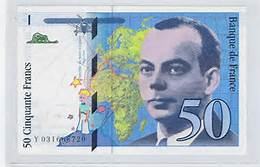
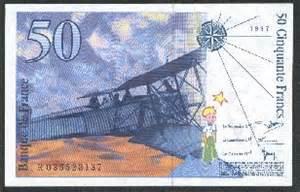
Francuska 100 Fr 1994 (preOero) vf/xf Antoine de Saint-Exupery KR157A
- Cijena
- 7,95 €
+ zaštita kupca 1,96 €
+ dostava 4,90 €
Besplatna BOX NOW dostava u Njuškalo appu
Promocija traje od 1.7. do 31.7.2026.

Saznaj više u Uvjetima promocije
Kupuj uz PayProtect od provjerenih prodavača uz garanciju povrata novca i sigurnu dostavu. Saznaj više
Šifra oglasa: 22103829
Osnovne informacije
- Lokacija
- Osječko-baranjska, Belišće, Belišće
- Stanje
- rabljeno
Opis oglasa
Pre Euro bill...
Franak je povijesno ime novčane jedinice nekoliko država. Smatra se da riječ franak dolazi od natpisa na latinskom jeziku "francorum rex" (kralj Franaka) koji je bio utisnut na prve francuske novčiće. Također postoji mišljenje kako riječ franak porijeklo vuče od riječi iz francuskog jezika franc koja znači "slobodan".
Franak je bio sredstvo placanja u Francuskoj, Belgiji, Monaku i Luksemburgu sve do uvođenja Eura 1. siječnja 2002. godine. Franak je još uvijek novčana jedinica u Švicarskoj. Osim Švicarske, franak je još uvijek novčana jedinica u bivšim francuskim kolonijama u Africi (tzv. Franak CFA) i Polineziji (tzv. Franak CFP).
Pre-euro money from France 50 French Francs Antoine de Saint-Exupéry banknote of 1997, issued by the Bank of France - Banque de France. French Franc the former standard monetary unit of France, most French dependencies, Andorra and Monaco, divided into 100 centimes, replaced by the euro in 2002.
Euro exchange rate: 50 francs are the equivalent of 7 euros 62 euro cents (fixed rate of 6.55957 francs for 1 euro)
Obverse: Portrait of Antoine de Saint-Exupéry, French writer, poet and aviator, author of The Little Prince, a beloved children's book, as well as a depiction of The Little Prince himself. Above the watermark, which is an image of Saint-Exupéry, can be found a drawing of an elephant inside a boa constrictor. This simple drawing is taken from Le Petit Prince. When the aviator was young, he had drawn a boa constrictor with an elephant inside, but only the shape of the elephant was apparent. In the background, a map of Europe and Africa and flying plane Latécoère 28. The Latécoère 28 was a successful French long-haul mail plane and passenger airliner of the 1930s. Its pilots included famous poets and French men of letters such as Antoine de Saint Exupéry and Jean Mermoz.
See Through: When the banknote is held up to the light, on the upper left side, there is see-through register which front and back elements of the motif combine to form the Little Prince standing on his home planet, Asteroid B-612.
Reverse: Breguet 14 - biplane over the desert with wild weather in the sky - Saint Exupery's aircraft on his mail rounds over the Sahara desert.
Printed in white ink, just below the watermark, is a copy of the ram that was rejected by the Little Prince.As it is printed in white ink, the image is, to all intents and purposes, hidden. However, if the note is tilted at a certain angle, light can be seen reflecting from the white ink and if the note is subjected to ultra-violet light the ram will fluoresce. The inclusion of the drawing of the elephant being digested by the boa constrictor and the "hidden" picture of a sheep create one of the nicest twists to the design of a banknote. The elephant inside the boa exemplifies those people who ‘always need explanations’. The sheep, on the other hand, is not initially apparent and reflects the conviction expressed in Le Petit Prince that ‘What’s essential remains invisible to the eye.’ The two drawings on the banknote are an esoteric interpretation of sentiments expressed in Saint-Exupéry’s work and prove that at least one banknote designer has a sense of the esoteric and, by hiding the sheep, a sense of fun. One can be certain that Le Petit Prince was bed-time reading for the designer, both as a child and as an adult.
The watermark is a portrait of Antoine de Saint-Exupéry. Dimensions are 123 mm x 80 mm.
Other security features include: Micro printing, miniature letters the colorless ink pattern, pattern color changing, transvision and "Strap". STRAP is a French abbreviation, meaning "reflecting strip for copying protection". It's a nice security feature, a polymer strip with transparent and foil-plated areas. It's use in driving the copying equipment crazy when trying to reproduce the banknote, as the reflective properties of the strip's areas are very different. Unfortunately, this feature is quite rarely seen on the notes (perhaps due to the expensiveness of production). The 50 francs Saint-Exupéry is a banknote in French francs with the effigy of the writer and aviator Antoine de Saint-Exupéry. This banknote was issued for replacing in circulation 50 francs notes Quentin de La Tour, it was created by the Bank of France on 10 March 1992 and came into circulation on October 20 1993. Emissions of these notes was discontinued on 31 December 2001 when euro banknotes came into circulation. Like all other franc banknotes replaced by the Euro (500 FF Pierre and Marie Curie, Gustave Eiffel 200 francs, 100 francs Cezanne, Debussy 20 francs), it ceased to be legal tender from 18 February 2002, remained exchangeable at branches of the Bank of France, at the Central Bank of French overseas departments until 17 February 2012 inclusive.
Franak je povijesno ime novčane jedinice nekoliko država. Smatra se da riječ franak dolazi od natpisa na latinskom jeziku "francorum rex" (kralj Franaka) koji je bio utisnut na prve francuske novčiće. Također postoji mišljenje kako riječ franak porijeklo vuče od riječi iz francuskog jezika franc koja znači "slobodan".
Franak je bio sredstvo placanja u Francuskoj, Belgiji, Monaku i Luksemburgu sve do uvođenja Eura 1. siječnja 2002. godine. Franak je još uvijek novčana jedinica u Švicarskoj. Osim Švicarske, franak je još uvijek novčana jedinica u bivšim francuskim kolonijama u Africi (tzv. Franak CFA) i Polineziji (tzv. Franak CFP).
Pre-euro money from France 50 French Francs Antoine de Saint-Exupéry banknote of 1997, issued by the Bank of France - Banque de France. French Franc the former standard monetary unit of France, most French dependencies, Andorra and Monaco, divided into 100 centimes, replaced by the euro in 2002.
Euro exchange rate: 50 francs are the equivalent of 7 euros 62 euro cents (fixed rate of 6.55957 francs for 1 euro)
Obverse: Portrait of Antoine de Saint-Exupéry, French writer, poet and aviator, author of The Little Prince, a beloved children's book, as well as a depiction of The Little Prince himself. Above the watermark, which is an image of Saint-Exupéry, can be found a drawing of an elephant inside a boa constrictor. This simple drawing is taken from Le Petit Prince. When the aviator was young, he had drawn a boa constrictor with an elephant inside, but only the shape of the elephant was apparent. In the background, a map of Europe and Africa and flying plane Latécoère 28. The Latécoère 28 was a successful French long-haul mail plane and passenger airliner of the 1930s. Its pilots included famous poets and French men of letters such as Antoine de Saint Exupéry and Jean Mermoz.
See Through: When the banknote is held up to the light, on the upper left side, there is see-through register which front and back elements of the motif combine to form the Little Prince standing on his home planet, Asteroid B-612.
Reverse: Breguet 14 - biplane over the desert with wild weather in the sky - Saint Exupery's aircraft on his mail rounds over the Sahara desert.
Printed in white ink, just below the watermark, is a copy of the ram that was rejected by the Little Prince.As it is printed in white ink, the image is, to all intents and purposes, hidden. However, if the note is tilted at a certain angle, light can be seen reflecting from the white ink and if the note is subjected to ultra-violet light the ram will fluoresce. The inclusion of the drawing of the elephant being digested by the boa constrictor and the "hidden" picture of a sheep create one of the nicest twists to the design of a banknote. The elephant inside the boa exemplifies those people who ‘always need explanations’. The sheep, on the other hand, is not initially apparent and reflects the conviction expressed in Le Petit Prince that ‘What’s essential remains invisible to the eye.’ The two drawings on the banknote are an esoteric interpretation of sentiments expressed in Saint-Exupéry’s work and prove that at least one banknote designer has a sense of the esoteric and, by hiding the sheep, a sense of fun. One can be certain that Le Petit Prince was bed-time reading for the designer, both as a child and as an adult.
The watermark is a portrait of Antoine de Saint-Exupéry. Dimensions are 123 mm x 80 mm.
Other security features include: Micro printing, miniature letters the colorless ink pattern, pattern color changing, transvision and "Strap". STRAP is a French abbreviation, meaning "reflecting strip for copying protection". It's a nice security feature, a polymer strip with transparent and foil-plated areas. It's use in driving the copying equipment crazy when trying to reproduce the banknote, as the reflective properties of the strip's areas are very different. Unfortunately, this feature is quite rarely seen on the notes (perhaps due to the expensiveness of production). The 50 francs Saint-Exupéry is a banknote in French francs with the effigy of the writer and aviator Antoine de Saint-Exupéry. This banknote was issued for replacing in circulation 50 francs notes Quentin de La Tour, it was created by the Bank of France on 10 March 1992 and came into circulation on October 20 1993. Emissions of these notes was discontinued on 31 December 2001 when euro banknotes came into circulation. Like all other franc banknotes replaced by the Euro (500 FF Pierre and Marie Curie, Gustave Eiffel 200 francs, 100 francs Cezanne, Debussy 20 francs), it ceased to be legal tender from 18 February 2002, remained exchangeable at branches of the Bank of France, at the Central Bank of French overseas departments until 17 February 2012 inclusive.
Karta
Napomena: Prikazana je približna lokacija
Senio965
Korisnik je verificirao broj telefona u državi: Hrvatska
Korisnik nije trgovac te na njega nisu primjenjive EU odredbe o zaštiti potrošača
- Adresa: 31551 Belišće, Osječko-baranjska, Hrvatska
- Oglas objavljen
- 03.07.2026. u 00:12
- Do isteka još
- Oglas prikazan
- 969 puta
Senio965
Korisnik je verificirao broj telefona u državi: Hrvatska
Korisnik nije trgovac te na njega nisu primjenjive EU odredbe o zaštiti potrošača
- Adresa: 31551 Belišće, Osječko-baranjska, Hrvatska